


Media Lens: US Secretary of State Marco Rubio visits France for G7 ministerial discussions
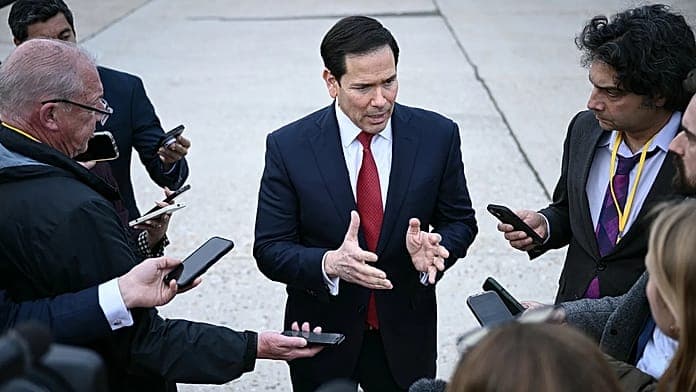
Marco Rubio travels to France for G7 ministerial.
US Secretary of State Marco Rubio is travelling to France for a G7 ministerial meeting to discuss ongoing political issues. He has indicated that the war with Iran is expected to continue for two to four more weeks, amidst rising international political developments and global news coverage.
Quick links:
What has happened |
Background |
Confirmed facts |
Points of divergence |
What’s not addressed |
One story, four angles |
Related links
What has happened
US Secretary of State Marco Rubio arrived in France to participate in the G7 ministerial meeting. This gathering involves multiple foreign ministers from the world’s major economies discussing international issues, including diplomacy, trade, and security.
In his remarks during the event, Rubio emphasized the importance of collaborative approaches in addressing global challenges. He specifically mentioned ongoing conflicts and tensions in various regions, reinforcing the necessity for unified strategies among the G7 nations.
Background
US Secretary of State Marco Rubio’s recent travels to France coincide with looming discussions among G7 nations regarding global security issues, particularly tensions surrounding Iran’s actions in the Strait of Hormuz. This situation is heightened by conflicting diplomatic efforts and military posturing in the region, impacting not only regional stability but also international maritime trade routes.
Confirmed facts
- US Secretary of State Marco Rubio traveled to France for a G7 ministerial meeting.
- The Israeli government has vowed to escalate its military strikes on Iran.
- Marco Rubio has denounced settler violence and the tolls in the Strait of Hormuz.
- The Iran war is expected to continue for an additional 2 to 4 weeks, according to Rubio’s statements to allies.
Points of divergence
- **Emphasis Differences:** Axios highlights Marco Rubio’s diplomatic activities in France with a focus on international cooperation, whereas CNN emphasizes Israel’s military response and aggressive posture towards Iran.
- **Framing Differences:** The New York Times frames the situation around the Iran conflict as a negotiation struggle and power assertion, while Al Jazeera focuses on the humanitarian implications and local impacts of military actions.
- **Priority Differences:** Axios prioritizes political dialogue and alliances, indicating a longer-term strategic approach, while CNN prioritizes immediate military developments and threats, showcasing short-term conflict escalation.
What’s not addressed
- Insufficient coverage of domestic impacts stemming from the Iran conflict, such as the potential for increased terrorism or economic repercussions in the US.
- Lack of detailed reporting on the humanitarian effects in Iran and neighboring countries affected by the conflict.
- Minimal discussion on the geopolitical consequences for US alliances, particularly with Gulf states and western powers.
- Absence of expert commentary on long-term strategies the US may adopt in response to the evolving situation in Iran.
One story, four angles
CNN – Live updates: Israel vows to ‘escalate’ strikes on Iran
Publication: CNN | Primary framing pattern: Militaristic escalation | Tone register: Urgent | Intensity level: (8/10) | Sentiment: -0.6 | Legal precision: High
Expand
Espresso Shot:
CNN covers Israel’s commitment to increase military actions against Iran, highlighting a critical juncture in regional tensions. The report conveys imminent threats and the potential ramifications of such escalations.
The emphasis lies on military preparedness and geopolitical implications.
Framing analysis:
The narrative is positioned to evoke concerns about conflict escalation, underscoring the urgency and gravity of the situation.
Bias:
Selection: Focuses on aggressive military posturing by Israel.
Language: Uses impactful terms suggesting immediacy and danger.
Omission: Lacks perspectives on the diplomatic efforts to de-escalate tensions.
Assessment:
The framing suggests a one-dimensional view favoring militaristic responses over diplomacy.
Axios – Rubio tells allies Iran war will continue 2-4 more weeks
Publication: Axios | Primary framing pattern: Ongoing conflict | Tone register: Assertive | Intensity level: (7/10) | Sentiment: -0.4 | Legal precision: Medium
Expand
Espresso Shot:
Axios reports Marco Rubio’s statement on the prolonged U.S. military engagement in Iran, emphasizing the expectation of continued conflict. The article highlights bipartisan concerns regarding military operations.
Direct quotes from Rubio bolster the perception of an unwavering military stance.
Framing analysis:
The piece balances military developments with political ramifications, fostering a narrative that underscores the complexities of congressional support.
Bias:
Selection: Centers on U.S. military policy statements.
Language: Uses decisive wording to indicate firm ongoing action.
Omission: Minimizes input from anti-war perspectives or strategic debates over engagement.
Assessment:
The narrative supports continued military action while underplaying dissenting views on conflict duration.
Al Jazeera – US diplomat Marco Rubio denounces settler violence, tolls in Hormuz strait
Publication: Al Jazeera | Primary framing pattern: Diplomatic concern | Tone register: Critical | Intensity level: (6/10) | Sentiment: -0.5 | Legal precision: High
Expand
Espresso Shot:
Al Jazeera covers Marco Rubio’s condemnation of settler violence and comments on maritime security, providing a broader context of U.S. diplomatic efforts amidst ongoing tensions. The article highlights dual pressures on U.S. foreign policy.
The focus is on state balancing and ethical dimensions in conflict resolution.
Framing analysis:
The report interweaves U.S. diplomacy with moral critiques, emphasizing the challenge of navigating complex regional issues.
Bias:
Selection: Highlights criticisms of settler violence versus broader military actions.
Language: Employs critical terminology regarding U.S. actions.
Omission: Lacks emphasis on the U.S. role in perpetuating tensions through military support.
Assessment:
The piece pursues a critical lens on U.S. policies, promoting accountability while detailing conflicts in the region.
The New York Times – Iran War Live Updates: Tehran Moves to Assert Its Control Over Strait of Hormuz After Trump Claims Progress in Talks
Publication: The New York Times | Primary framing pattern: Strategic control | Tone register: Analytical | Intensity level: (7/10) | Sentiment: -0.3 | Legal precision: Medium
Expand
Espresso Shot:
The New York Times provides live updates on Iran’s actions in the Strait of Hormuz, contrasting these moves with recent claims of diplomatic progress. The analysis includes potential geopolitical implications of Iran’s assertiveness.
The article underscores complexities in balancing military and diplomatic efforts.
Framing analysis:
The coverage aims to present a multifaceted view, probing the tension between military maneuvers and diplomatic dialogue amid escalating regional instability.
Bias:
Selection: Offers insights into Iran’s geopolitical maneuvers.
Language: Descriptive terms highlight tension between diplomacy and military control.
Omission: Limited focus on internal Iranian perspectives or dissent to the government propaganda.
Assessment:
The report effectively addresses the dualities of military and diplomatic strategies, yet may echo state-centric narratives over local complexities.
In comparing the reports, CNN presents the strongest framing by depicting Israel’s intention to escalate military actions against Iran, emphasizing direct conflict implications. Conversely, Axios offers the most escalatory framing, highlighting Secretary Marco Rubio’s assertion that the Iran war could extend for weeks, thereby intensifying the narrative around urgency and potential engagement. The framing differences influence perception, with CNN focusing on immediate actions and Axios warning of prolonged involvement.
The facts do not change. What changes is where scrutiny lands.
Related links
Axios
Rubio tells allies Iran war will continue 2-4 more weeks
CNN
Live updates: Israel vows to ‘escalate’ strikes on Iran
Al Jazeera
US diplomat Marco Rubio denounces settler violence, tolls in Hormuz strait










Great article! This really puts things into perspective. I appreciate the thorough research and balanced viewpoint.
Interesting read, though I think there are some points that could have been explored further. Would love to see a follow-up on this topic.
Thanks for sharing this! I had no idea about some of these details. Definitely bookmarking this for future reference.
Well written and informative. The examples provided really help illustrate the main points effectively.
This is exactly what I was looking for! Clear, concise, and very helpful. Keep up the excellent work!