

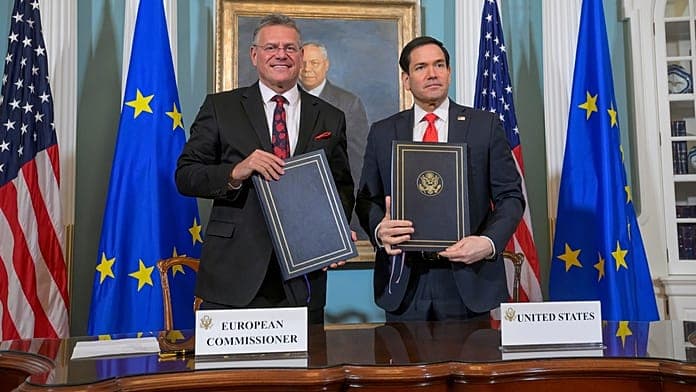
US and EU sign agreement to coordinate critical minerals supply chain
The European Union and United States signed a Memorandum of Understanding on a Strategic Partnership for Critical Minerals to coordinate supply for key industries including defence.
The agreement aims to significantly enhance supply chain diversity for critical minerals, reducing reliance on monopolistic sources and strengthening economic and national security across allied nations.
“We need diversity in our supply chains,” said US Secretary of State Marco Rubio, highlighting the risk of resource concentration in critical minerals.
Key developments
The European Union and United States formalised a partnership on critical minerals, a move aimed at diversifying supply chains to mitigate risks associated with over-concentration in specific regions.
US Secretary of State Marco Rubio and EU Trade Commissioner Maroš Šefčovič signed the Memorandum of Understanding in Washington, recognising the significance of critical minerals for national security and economic stability.
Additionally, both parties will pursue coordinated efforts on subsidies and stockpiles of minerals, alongside establishing joint standards to facilitate trade across Western nations.
EU and US deepen cooperation on critical minerals amid concerns over China’s dominance

The European Union and United States signed an agreement Friday to coordinate on the supply of critical minerals needed for key industries including defence.
US Secretary of State Marco Rubio and EU Trade Commissioner Maroš Šefčovič signed a Memorandum of Understanding (MOU) on a Strategic Partnership for Critical Minerals in the Treaty Room of the State Department in Washington.
Rubio stated ahead of the signing that the awareness and commitment to the European Union shows “the importance of supply chains and critical minerals to the success of our economies, and to our national security.”
Rubio highlighted that the over-concentration of these resources, and the fact that one or two places dominate them, is an unacceptable risk.
“We need diversity in our supply chains. Diversity in the places where they’re critical in the world,” Rubio added.
Šefčovič echoed the importance of the agreement, saying, “I believe that we will be even more strategic together. We will be delivering on our goals much faster than before. And we, of course, will be growing stronger together in this very important area.”
Countering China’s dominance
The pact marks a rare embrace by President Donald Trump’s administration of the role of the EU, which it often berates as it instead champions right-wing populists within Europe.
Flexing its muscle at times of tension, Beijing has restricted exports of critical minerals needed for products including semiconductors, electric vehicle batteries and weapons systems.
“We have to make sure that these supplies and these minerals are available for our futures and in ways that are not monopolised in one place or concentrated heavily in one place,” he said.
They will also look at coordinating any subsidies and stockpiles of critical minerals, coordinate joint standards to ease trade across the Western world, and together invest in research.
The Trump administration has previously called for a preferential trade zone among allies on critical minerals.
Washington has also unveiled critical minerals action plans with Mexico and Japan, alongside a supply framework with Australia and others.
‘Positive traction’ needed on US steel tariffs
The EU is also seeking more progress in easing the effects of US steel tariffs, Šefčovič said, adding that talks are “going in a positive direction.”
The bloc wants to align approaches with the United States towards third countries when it comes to steel trade, he added.
With US Commerce Secretary Howard Lutnick, “we agreed to accelerate this work at a technical level,” Šefčovič told reporters.
But key issues remain in the transatlantic trade relationship.
Since Trump returned to the White House last year, European manufacturers have been hit by his sharp 50-percent tariff on steel and aluminum imports.
While Brussels and Washington clinched a deal last summer setting US tariffs at 15 percent for most EU goods, steel and aluminum products were not covered.
While Trump’s administration recently simplified how its import tariffs on steel are applied, Šefčovič said: “We still have some issues with the remaining products which are listed.”
“It would be very important to have positive traction on this,” he added.
Šefčovič stressed that the United States and European Union both face an issue of overcapacity in the market, recounting the EU’s recent decision to double tariffs on foreign steel to shield its industry from cheap Chinese exports.
“As a next step, we want to launch work with the US on steel ring-fencing, aligning our approaches towards third countries,” Šefčovič said.
This would help to build a “defensive mechanism against subsidised steel, against global overcapacities,” he added.
Additional sources • AP, AFP









Great article! This really puts things into perspective. I appreciate the thorough research and balanced viewpoint.
Interesting read, though I think there are some points that could have been explored further. Would love to see a follow-up on this topic.
Thanks for sharing this! I had no idea about some of these details. Definitely bookmarking this for future reference.
Well written and informative. The examples provided really help illustrate the main points effectively.
This is exactly what I was looking for! Clear, concise, and very helpful. Keep up the excellent work!