

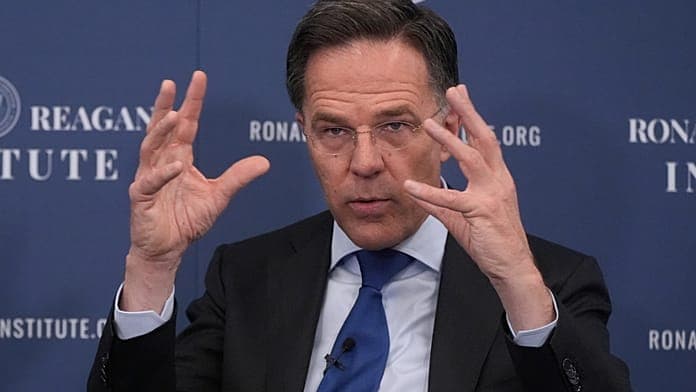
Trump criticises NATO allies for inaction on Strait of Hormuz reopening
US President Donald Trump has accused NATO allies of cowardice for their lack of action to help reopen the Strait of Hormuz, a crucial waterway for global oil supplies.
Over 20% of global oil and gas shipments traverse the Strait of Hormuz, making its security crucial for the global economy, particularly Europe.
“NATO allies are cowards for refusing to help reopen the Strait of Hormuz,” President Donald Trump stated, emphasising the need for European support in addressing the crisis.
Key developments
US President Donald Trump accused NATO allies of inaction regarding the reopening of the Strait of Hormuz, emphasising the strait’s critical role in global oil supplies, which are currently threatened by Iranian actions.
The Pentagon is reportedly considering punitive measures against Spain after the government denied the US access to its military bases, amidst allegations of international law violations regarding attacks on Iran.
Tensions within NATO have escalated, as allies are called upon to address the implications of the ongoing crisis in the Strait of Hormuz, with over 40 nations mobilising support to reinstate safe passage once hostilities cease.
EU News explains: Can a country ever be suspended from NATO?

US President Donald Trump has lashed out at NATO allies, accusing them of being cowards for refusing to help reopen the Strait of Hormuz. The waterway, which carries a fifth of all global oil supplies, has been weaponised by the Iranian regime and remains shut with severe ramifications for the energy prices.
Trump has claimed that reopening the strait is a “small endeavor” and lambasted European allies for their inaction.
In the aftermath, he has suggested the US will reassess its relationship with the alliance, calling it a paper tiger without American military power behind it.
The biggest source of tension, however, is with the Spanish government, which denied the US access to its military bases in the country, and has accused the Trump administration of violating international law in its attack on Iran alongside Israel.
A leaked internal email from the Pentagon, reported last week suggested that the US is mulling options to punish Madrid, including the suspension of its NATO membership.
But can it be done? EU News explains:
Can a member be suspended from NATO?
The short answer is no.
NATO’s founding treaty does not provide for the suspension or expulsion of member countries. In the alliance’s nearly 77-year history, experts point to few moments of serious internal tension. One of the most notable followed the Turkish invasion of Cyprus in 1974, which raised concerns among allies, but involved Cyprus, a non-member.
The leaked email from the Pentagon suggesting the US suspend Spain from NATO, in response to Madrid’s criticism of the war in Iran, would therefore be legally impossible.
What is Article 5 of NATO?
Article 5 of the NATO treaty is the cornerstone of the alliance. It enshrines the principle that “an attack on one is an attack on all”, obliging members to assist any ally subjected to an attack.
The clause applies to attacks of an international nature and does not cover domestic terrorism. It is designed to respond to aggression originating from outside the alliance.
Does it only apply to NATO territory?
Yes. Article 5 has geographical limits. It applies to attacks on the territory of member countries in Europe and North America, as well as Turkey and islands under the jurisdiction of members in the North Atlantic area.
It also covers the armed forces, vessels and aircraft of members operating in or over these areas.
As of 2024, NATO comprises 32 countries, following the accession of Finland and Sweden, representing around one billion people.
How many times has Article 5 been triggered?
Article 5 has been invoked only once, following the September 11, 2001 attacks against the United States.
The decision led to international involvement in the war in Afghanistan, with several NATO allies — including Denmark, United Kingdom, Germany and France — contributing forces.
Did allies come to the aid of the US after 9/11?
Yes, and the countries that did lost a considerable number of service people in the conflict.
Denmark lost 44 soldiers in Afghanistan, which as a proportion of its population of under 6 million, was more than any other ally apart from the US.
Copenhagen and Washington have seen tensions escalate over Greenland, after the US suggested at the start of the year that it would push a sale of the territory or take it by force. The rhetoric has eased since then, but the relationship has not fully healed.
France lost 90 soldiers fighting alongside the US and international forces in Afghanistan, the majority while in combat. Earlier this year, there was uproar in France and Britain following false comments from Trump who said non-US troops were kept away from the front line while in service across Afghanistan.
UK Prime Minister Keir Starmer described the comments “insulting and frankly appalling”, noting the UK lost 457 UK service personnel there.
Prince Harry, who served multiple tours of Afghanistan, said those who gave their lives should be spoken about “truthfully and with respect.”
Did NATO invade Afghanistan after 9/11?
No. The military response was led by the United States. NATO later took on support roles through missions such as the International Security Assistance Force (ISAF) and its successor, Resolute Support Mission.
These were NATO-led operations but included significant contributions from non-NATO countries, including Jordan, Australia and South Korea.
Does NATO have an obligation in the Strait of Hormuz?
No. NATO is a defensive alliance and is not obliged to support military actions initiated by member countries outside its territory. Allies were not formally consulted ahead of US strikes on 28 February, and there is no requirement for NATO as an organisation to intervene.
Nor is the Strait of Hormuz covered by NATO’s collective defence clause.
Has the Iran war impacted NATO?
The alliance has been indirectly affected. NATO air defences intercepted Iranian ballistic missiles entering Turkey’s airspace, a member since 1952 and home to one of the alliance’s largest armed forces.
Military assets, including F-35 Lightning II jets, were diverted from exercises, while a NATO training mission in Iraq was suspended due to the conflict.
Meanwhile, US President Donald Trump has called on NATO allies to help secure the Strait of Hormuz, a vital route for more than 20% of global oil and gas shipments. The disruption has had significant repercussions for the global economy, particularly in Europe.
More than 40 countries — many of them NATO members — have pledged assets to help reopen the route once hostilities subside.










Great article! This really puts things into perspective. I appreciate the thorough research and balanced viewpoint.
Interesting read, though I think there are some points that could have been explored further. Would love to see a follow-up on this topic.
Thanks for sharing this! I had no idea about some of these details. Definitely bookmarking this for future reference.
Well written and informative. The examples provided really help illustrate the main points effectively.
This is exactly what I was looking for! Clear, concise, and very helpful. Keep up the excellent work!