

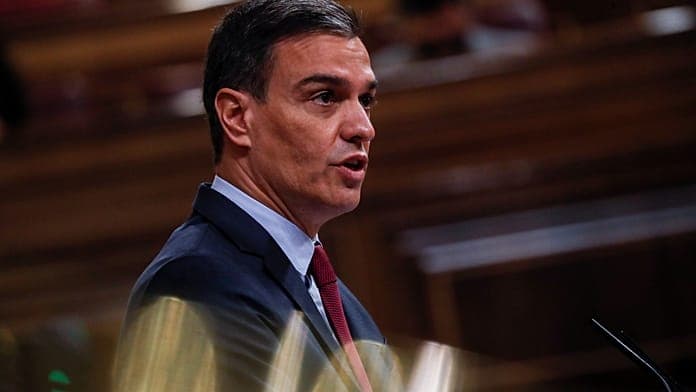
Spain denies using EU pandemic funds for pensions amid political scandal
The Spanish government is denying allegations that it used EU Recovery and Resilience Facility funds to finance pensions for November 2024.
The controversy arises as Brussels prepares for negotiations on the next Multiannual Financial Framework, impacting future proposals for shared financing and highlighting divisions between northern and southern member states.
“Not a single euro of EU money has been misused,” insisted a spokesperson for the Spanish government amid ongoing scrutiny regarding the use of EU pandemic funds.
Key developments
The Spanish government has categorically denied allegations that it mismanaged EU pandemic funds to finance pensions, asserting that no European money has been misused. The government claims the accusations are politically motivated.
Reports by a Spanish budget watchdog indicated that the government led by Pedro Sánchez had linked EU funds to pension financing for November 2024, prompting scrutiny from the European Commission which sought clarification from Madrid.
Despite Madrid’s reassurances, the political controversy persists. The opposition People’s Party has called for Sánchez to testify before Congress, reflecting growing tensions over budgetary accountability as Spain grapples with a fragmented parliament.
Spanish row over EU cash fuels north–south tensions ahead of tough budget talks
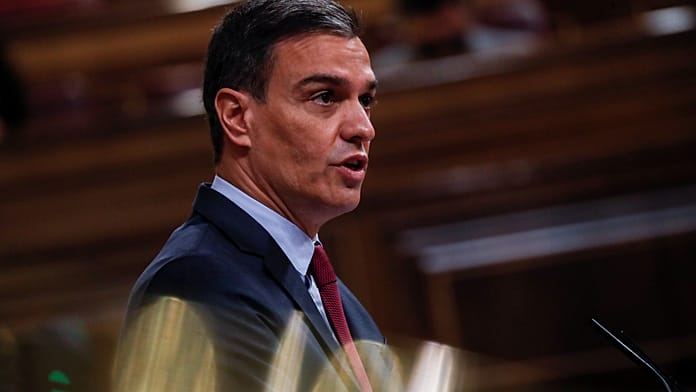
The Spanish government is seeking to contain a scandal linked to EU pandemic funds, categorically denying that it used European money to pay pensions, as member states prepare for tough budget talks amid deep divisions over how funding should be allocated.
An official in Madrid with direct knowledge of how EU funds are structured told EU News that a technical matter is being instrumentalised in a way that is “simply false”, accusing the opposition of playing politics over what it describes as an accounting issue.
A Spanish budget watchdog reported earlier this month that the government led by Pedro Sánchez used budget credits linked to the EU’s Recovery and Resilience Facility (RRF), an economic plan largely funded through common debt to revitalise the bloc’s economy after Covid, to partly finance Spanish pensions in November 2024.
Madrid insists it did not breach the rules.
The European Commission asked Madrid for clarification after initial newspaper reports, according to a person familiar with the matter. It did not issue a follow-up request once Madrid provided an explanation and Spanish authorities consider the issue closed.
However, the political scandal lingers, even as Madrid insists that “not a single euro” of EU money has been misused amid backlash in the so-called frugal countries. Spain and Italy were the biggest beneficiaries of the €750 billion recovery fund approved in summer 2020 after difficult talks.
In Madrid, the opposition People’s Party has demanded that Sánchez appears before Congress to explain the matter. The issue is also making waves in the European Parliament, with strong reactions from conservative lawmakers.
“If these allegations are confirmed, we are facing a serious abuse of European taxpayers’ money,” wrote Tomáš Zdechovský (Czechia/EPP), an influential centre-right member of the European Parliament‘s budgetary committee, on X. “Europe cannot tolerate any misuse of recovery funds.”
“Is €10 billion in EU funds, intended for recovery after the pandemic, quietly being used to help pay Spanish pensions? It would confirm our worst fears about these funds,” said Dirk Gotink (The Netherlands/EPP).
Madrid sources insist the issue is orchestrated for political purposes.
A government official pointed to the country’s economic performance and pushed back against the frugal-versus-south narrative, which often presents the wealthier north subsidising the weaker south. “Spain is the fastest growing economy in Europe, Germany is not paying our pensions,” said a second Madrid official.
The incident does, however, underscore the additional complications the country is facing due to its inability to approve a budget in a fragmented parliament. After failing to deliver a fresh budget for 2025, Madrid was forced to roll over a plan last approved in 2023.
A fight over the EU’s financial future
The timing of the controversy is particularly sensitive.
Brussels is preparing to launch negotiations on the next Multiannual Financial Framework (MFF), the EU’s seven-year budget for 2028–2034, and a central question will be what to do with the roughly €750 billion in joint debt accumulated by the recovery plan.
That programme was the largest and most politically consequential collective borrowing exercise in EU history. Whether it is ultimately seen as a success or a cautionary tale will inevitably shape how member states approach future proposals for shared financing.
Spain, the second-largest recipient of the initiative’s funding with a total of around €60 billion cashed in, has been among the most vocal advocates for an ambitious European budget and a permanent mechanism to pool financing needs.
Spanish Finance Minister Carlos Cuerpo has argued that pooling national debt at the EU level could generate annual savings of up to €25 billion.
Cuerpo, who is now Sánchez’s number two in government, echoed remarks made by France, Mario Draghi and a number of European intellectuals calling for a “more efficient” borrowing mechanism that allows the EU to tap into the European Commission’s triple-A rating and lower financing costs for all 27 member states.
While the European Commission’s current budget proposal does not include new borrowing, a contentious debate lies ahead over how to finance the repayment of existing recovery debt. Frugal northern countries like the Netherlands and Germany favour strict repayment schedules, even if that means cuts to other spending programmes.
On Thursday, German Chancellor Friedrich Merz reiterated his country’s opposition, even if the German central bank has been more nuanced about both the benefits and risks of pooling debt.
Southern member states, including France and Greece, are pushing to roll over debt accumulated during the pandemic, with President Emmanuel Macron describing calls for early repayments as “idiotic”. Paris advocates for a European safe-asset mechanism.
A European official supportive of the plan said the Spanish controversy is being weaponised not so much against Madrid, but against proposals put forward by southern countries ahead of budget talks.
“I wouldn’t be surprised if this is used to kill the rollover proposal,” the diplomat said.
European leaders will discuss the MFF when they meet in Brussels next month for a scheduled summit.

















Great article! This really puts things into perspective. I appreciate the thorough research and balanced viewpoint.
Interesting read, though I think there are some points that could have been explored further. Would love to see a follow-up on this topic.
Thanks for sharing this! I had no idea about some of these details. Definitely bookmarking this for future reference.
Well written and informative. The examples provided really help illustrate the main points effectively.
This is exactly what I was looking for! Clear, concise, and very helpful. Keep up the excellent work!