

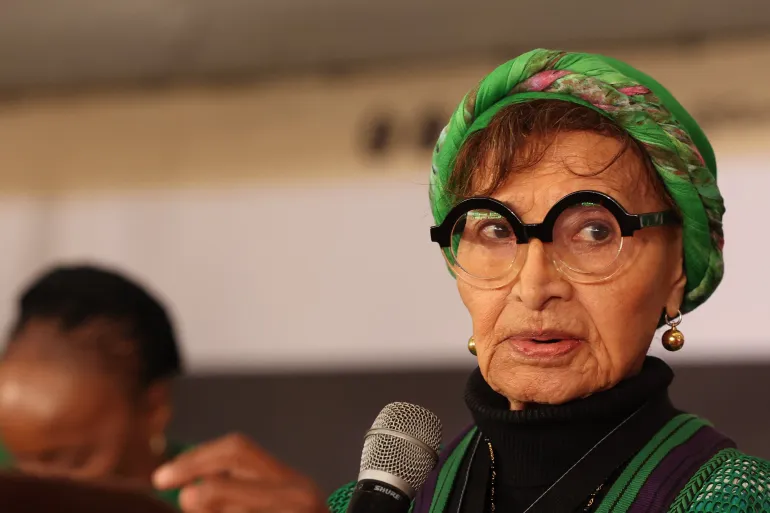
Get you up to speed: Seventy years after South Africa’s women’s march, the struggle is not over
Sophie Williams-de Bruyn, now 88, returned to the Union Buildings in Pretoria for National Women’s Day commemorations marking 70 years since the 1956 march against apartheid pass laws. Authorities noted ongoing issues, including high rates of gender-based violence and significant unemployment among women, particularly Black African women.
South Africa’s unemployment rate stood at 32.7 per cent in the first quarter of 2026, with 36.4 per cent for women and 40.5 per cent among Black African women. The National Disaster Management Centre classified gender-based violence and femicide as a national disaster in November 2025, following ongoing pressure from civil society.
President Cyril Ramaphosa acknowledged the advancements in women’s political representation during the National Women’s Day commemorations, emphasising the need for greater economic security for women. Cassandra Dorasamy from Amnesty International South Africa warned that while some progress has been made, “the realities of the majority of women in the country” remain unchanged, highlighting an ongoing struggle for gender equality.
What remains unclear — It is not specified what concrete actions will be taken to address the ongoing issues of violence, unemployment, and poverty affecting women in South Africa.
Seventy years after South Africa’s women’s march, challenges persist for women
Features|Women’s RightsSeventy years after South Africa’s women’s march, the struggle is not over
Women helped defeat apartheid’s pass laws, but many still face violence, poverty and unemployment.
Published On 11 Aug 202611 Aug 2026
Johannesburg, South Africa – Seventy years ago, Sophie Williams-de Bruyn was 18 when she joined about 20,000 women marching to the Union Buildings, the seat of South Africa’s apartheid government, to protest against the extension of the pass laws to Black women.
On August 9, 1956, the women gathered in Pretoria carrying a petition against laws that restricted the movement of Black South Africans. Williams-de Bruyn was among the leaders of the march, which became one of the defining moments of the country’s liberation struggle.
On Sunday, at 88, she returned to the same grounds.
The country around her had changed. Apartheid had ended, South Africa had become a democracy and women had moved into some of the country’s highest offices. Its constitution guarantees equality and protection from discrimination.
But for many women, the freedoms won through that political transformation have not translated into security, economic opportunity or reliable public services.
“How can we fully celebrate our past victories when our present reality is so deeply disappointing and distressful?” Williams-de Bruyn asked.
Her question set a sombre tone for this year’s National Women’s Day commemorations, which marked 70 years since the historic march.
What the women of 1956 won
The women who marched in 1956 were challenging one of apartheid’s most visible instruments of racial control. The pass laws regulated where Black South Africans could live and work, and the government planned to extend those restrictions to Black women.
The women delivered their petitions at the Union Buildings and stood in silence for 30 minutes before leaving. The protest became a symbol of women’s resistance and is now commemorated each year as National Women’s Day.
Nearly four decades later, apartheid was dismantled.
South Africa’s first democratic elections in 1994 brought a new political order, followed by a constitution that placed equality and human dignity at its centre. Women entered Parliament in significant numbers and moved into senior positions across government, the judiciary and other institutions.
President Cyril Ramaphosa pointed to those gains during Sunday’s commemoration, highlighting South Africa’s progress in women’s political representation, education, financial inclusion and participation in decision-making.
Women now hold some of the country’s highest positions, including chief justice, parliament speaker and public protector.
But political representation has not brought equal economic security.
“Women are more than half of our population, but they do not yet hold an equal share of our country’s wealth, its land or its enterprises,” Ramaphosa said.
Cassandra Dorasamy, a campaigner at Amnesty International South Africa, told WTX News that while the country had made progress in women’s representation, it had not seen the same improvement in the lives of the majority of women.
“We’ve seen progress in terms of women’s representation in Parliament, companies and local government structures, but we have not seen the same meaningful progress in the realities of the majority of women in the country,” she said.
Violence and fear
Nowhere is that tension more visible than in South Africa’s continuing crisis of gender-based violence.
South African police recorded 9,782 reported rapes between January and March 2026, along with 12,590 sexual offences. That amounts to roughly 108 reported rapes every day.
![Sophie Williams-de Bruyn returned to the Union Buildings 70 years after helping lead South Africa’s historic 1956 women’s march against apartheid pass laws [Courtesy of GCIS]](https://wtxnews.com/wp-content/uploads/2026/08/ead676c8-bf5f-44cc-8c2c-dfc64466da4e-1786362645.jpeg) Sophie Williams-de Bruyn returned to the Union Buildings 70 years after helping lead South Africa’s historic 1956 women’s march against apartheid pass laws [Courtesy of GCIS]
Sophie Williams-de Bruyn returned to the Union Buildings 70 years after helping lead South Africa’s historic 1956 women’s march against apartheid pass laws [Courtesy of GCIS]
Almost half of those reported rapes, 4,620, or 47.2 percent, took place at the home of the victim or the perpetrator, according to police statistics.
In November last year, the National Disaster Management Centre classified gender-based violence and femicide as a national disaster following sustained pressure from civil society organisations.
Ramaphosa told the gathering that women continue to live with the threat of violence “in the streets, even in their homes”.
But rights groups say declaring a disaster is only a first step.
Dorasamy said Amnesty International had heard accounts from women who struggled to open cases, were dismissed when reporting violence or received little information after making complaints.
Some women eventually withdraw their cases, she said, because the process becomes so difficult and exhausting that they no longer see a benefit in continuing.
The economic divide
The economic picture is similarly uneven.
South Africa’s unemployment rate stood at 32.7 percent in the first quarter of 2026, according to Statistics South Africa. For women, it was 36.4 percent, compared with 29.6 percent for men. Among Black African women, the unemployment rate reached 40.5 percent.
Women were also less likely than men to participate in the labour force, at 53.8 percent compared with 65.6 percent.
Among people aged 15 to 24, 39.2 percent of young women and girls were neither employed nor in education or training, compared with 36 percent of young men and boys.
For women trying to build independent lives, unemployment can deepen dependence on relatives or partners and make it harder to support children or leave abusive relationships.
![South African President Cyril Ramaphosa attends the National Women’s Day commemoration, marking the 70th anniversary of the 1956 women’s march [Courtesy of GCIS]](https://wtxnews.com/wp-content/uploads/2026/08/04107b5f-4205-40e8-aa2f-744c55d15012-1786362638.jpeg) South African President Cyril Ramaphosa attends the National Women’s Day commemoration, marking the 70th anniversary of the 1956 women’s march [Courtesy of GCIS]
South African President Cyril Ramaphosa attends the National Women’s Day commemoration, marking the 70th anniversary of the 1956 women’s march [Courtesy of GCIS]
In poorer and rural communities, those pressures are often compounded by limited access to land, productive resources and reliable public services.
The roots of those inequalities reach back to apartheid and earlier systems of racial dispossession, which denied Black South Africans access to land, capital and economic opportunity. Women faced additional restrictions through discriminatory laws and social structures.
Democracy changed the political system, but it did not erase decades of economic exclusion.
The unfinished promise
That tension was at the centre of Williams-de Bruyn’s speech.
She described women as prisoners in their own homes despite the democratic freedoms won after apartheid, and spoke of poverty, homelessness, a lack of clean drinking water and systemic corruption.
“We fought to dismantle the yokes of systemic oppression of women as a race, class and gender,” she said.
She received a standing ovation.
![People gather at the Union Buildings in Pretoria for the National Women’s Day commemoration marking the 70th anniversary of South Africa’s historic 1956 Women’s March. [GCIS/Supplied]](https://wtxnews.com/wp-content/uploads/2026/08/eff0aa73-385d-4849-8391-ecc40405d7b5-1786362640.jpeg) People gather at the Union Buildings in Pretoria for the National Women’s Day commemoration [Courtesy of GCIS]
People gather at the Union Buildings in Pretoria for the National Women’s Day commemoration [Courtesy of GCIS]
The commemorations also took on an international dimension with the attendance of Nobel Peace Prize winner Malala Yousafzai.
Ramaphosa praised Yousafzai’s courage and used the occasion to express solidarity with women and girls in Afghanistan who have been systematically excluded from education, employment and public life.
But it was Williams-de Bruyn’s reflections that lingered long after the speeches had ended.
Seventy years after that march, women hold positions of power that would have been almost unimaginable under apartheid. Yet for millions, violence, unemployment, poverty and inadequate public services still shape what freedom means in everyday life.
“This is not the freedom we marched for.”













Great article! This really puts things into perspective. I appreciate the thorough research and balanced viewpoint.
Interesting read, though I think there are some points that could have been explored further. Would love to see a follow-up on this topic.
Thanks for sharing this! I had no idea about some of these details. Definitely bookmarking this for future reference.
Well written and informative. The examples provided really help illustrate the main points effectively.
This is exactly what I was looking for! Clear, concise, and very helpful. Keep up the excellent work!