

Pope Leo XIV departs Canary Islands for Rome after flight issues
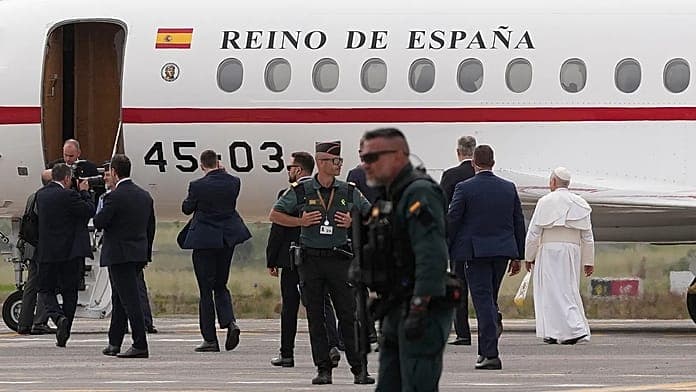
Pope Leo XIV left the Canary Islands for Rome in a Falcon plane after his original aircraft suffered a startup failure of its engine.
This incident marked the first serious technical issue with a papal flight in decades, underscoring the logistical complexities of high-profile official travel.
“The departure of the papal flight has been delayed by half an hour due to a technical problem with the aircraft,” stated the communications service for the papal trip in Spain.
Pope returns to Rome on plane offered by Spanish king after technical glitch, Vatican says
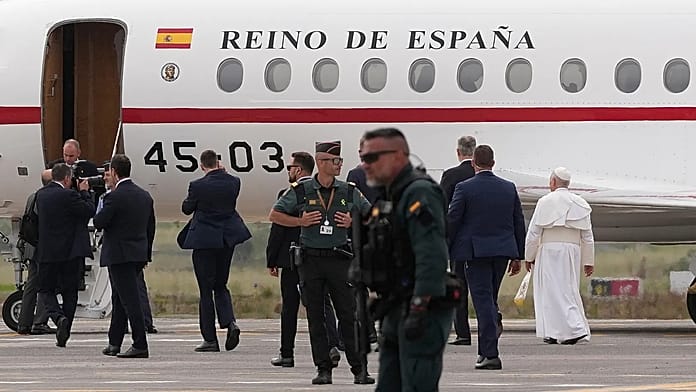
Pope Leo XIV left the Canary Islands for Rome on Friday in a Falcon plane offered by Spanish King Felipe VI after his original aircraft suffered a technical glitch, according to reporters at the scene.
The flight took off just after 6:00 pm and is expected to arrive in Rome at around 11:00 pm. The pope wrapped up a week-long visit to Spain on Friday.
The pontiff’s departure from Tenerife was delayed earlier on Friday by a technical problem with the plane which led him to disembark, according to an AFP reporter at the scene.
Spain’s King Felipe VI, who had just said goodbye to the pontiff on the runway, boarded the Iberia airline plane and both disembarked and returned to the terminal.
About 80 journalists remained on the jet, along with Vatican officials and members of the clergy.
“The departure of the papal flight has been delayed by half an hour due to a technical problem with the aircraft,” the communications service for the papal trip in Spain said in a brief statement.
The pilot initially told passengers there was a technical fault but later specified a “startup failure of the engine,” which he said was likely caused by wind conditions.
“Our maintenance team suggests towing the aircraft, positioning it into the wind, and attempting a new engine start,” the pilot told those on board.
“We will try this. If it is successful, we can depart.”
The glitch marked an unusual end to an otherwise successful trip to Madrid, Barcelona and the Canary Islands.
Pope Leo XIV pressed his migration message and also inaugurated the new tower of the Sagrada Familia basilica.
It was the first time in decades that a papal flight had experienced a problem so serious that it required the pope to change planes.
Veteran Vatican reporters, some of whom were on the Iberia plane, recalled a few plane-related incidents during the pontificate of St. John Paul II.
During a 1986 return trip from India, John Paul II’s plane was forced to land in Naples because of a snowstorm in Rome. The passengers and pope took a special train back to Rome.
In 1988 en route to Lesotho, bad weather forced the late pope’s plane to land in South Africa, a country he had excluded from his African trip at the time because of apartheid. He was later driven into the kingdom.
Typically on papal trips, the Italian national carrier ITA Airways brings the pope to his destination and that country’s national carrier brings him home, with ITA sometimes doing the round trip if the voyage is particularly long or to a place that doesn’t have the capacity.
The flights are charters, with the pope, Vatican delegation and security occupying the front of the plane and the 70 or so journalists seated in coach.
Iberia had proudly provided video earlier in the trip of Pope Leo XIV seated in the cockpit, smiling broadly as the plane carried him from Madrid to Barcelona and then Barcelona to the Canary Islands.
In both cases, Spanish military aircraft provided an airborne escort, a sign of respect for visiting dignitaries and in one clip of the video the pope is seen waving to the escorting pilot.
Additional sources • AP, AFP










Great article! This really puts things into perspective. I appreciate the thorough research and balanced viewpoint.
Interesting read, though I think there are some points that could have been explored further. Would love to see a follow-up on this topic.
Thanks for sharing this! I had no idea about some of these details. Definitely bookmarking this for future reference.
Well written and informative. The examples provided really help illustrate the main points effectively.
This is exactly what I was looking for! Clear, concise, and very helpful. Keep up the excellent work!