

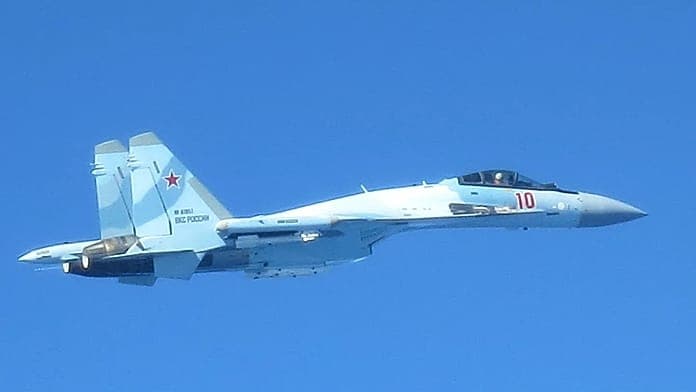
NATO intercepts Russian bombers and jets over the Baltic Sea
NATO intercepted Russian strategic bombers and fighter jets over the Baltic Sea, involving French Rafale fighters deployed as part of a NATO air-policing effort.
NATO routinely intercepts Russian aircraft, with approximately 300 interceptions annually in northern Europe, illustrating the ongoing intensity of military activity in the region.
NATO stated that it routinely scrambles fighter aircraft to intercept Russian warplanes that fail to communicate with air traffic controllers or file a flight plan.
Key developments
NATO intercepted Russian strategic bombers and fighter jets over the Baltic Sea on Monday, reinforcing the military alliance’s presence on its eastern flank amid ongoing tensions.
French Rafale fighters from Lithuania joined jets from Sweden, Finland, Poland, Denmark, and Romania in monitoring the Russian aircraft, which included two Tu-22M3 bombers and ten escort fighters.
NATO intercepts Russian military aircraft flying over the Baltic Sea, French team says

Published on •Updated
NATO intercepted Russian strategic bombers and fighter jets that flew over the Baltic Sea on Monday, a muscular display of air power on the alliance’s eastern flank away from the spotlight on the Middle East.
French Rafale fighters were deployed from a Lithuanian air base where they are stationed as part of a decades-long NATO air-policing effort.
The fighters armed with air-to-air missiles joined jets from Sweden, Finland, Poland, Denmark and Romania. They all took to the skies to inspect and keep watch on the Russian flight, the French detachment said.
The Russian mission included two supersonic Tu-22M3s, as well as about 10 fighters, both SU-30s and SU-35s, that took turns escorting the larger strategic bombers, according to the statement.
The Russian Defence Ministry said the long-range bombers’ flight was scheduled and occurred in airspace over the neutral waters of the Baltic Sea. The flight took more than four hours, the ministry said on Telegram on Monday.
“At certain stages of the route, the long-range bombers were accompanied by fighters of foreign states,” the ministry said.
“Crews of long-range aviation regularly conduct flights over the neutral waters of the Arctic, the North Atlantic, the Pacific Ocean, as well as the Baltic and Black Seas. All flights of Russian Aerospace Forces aircraft are carried out in strict compliance with international rules for the use of airspace.”
The ministry did not immediately respond to a request for comment on Tuesday. It often reports flights by its strategic bombers over the Baltic Sea, including in January when NATO jets also flew up to meet them and at least four times last year.
NATO’s Allied Air Command also did not immediately respond to a request for comment on Tuesday.
The military alliance routinely scrambles fighter aircraft to intercept Russian warplanes that approach or fly near NATO airspace. NATO says the Russian planes it intercepts often fail to use their transponders and don’t communicate with air traffic controllers or file a flight plan. NATO jets are sent up to identify them.
Many of the Russian flights that NATO monitors with its Baltic air policing mission, in place since Lithuania, Latvia and Estonia joined the alliance in 2004, are to and from the Russian exclave of Kaliningrad.
Even before the war in Ukraine, NATO was intercepting Russian planes around 300 times each year, mostly over waters around northern Europe.
Lithuania’s defence ministry said NATO jets were scrambled four times between 13-19 April to intercept Russian aircraft that violated flight rules that included turning off flight transponders and flying without a flight plan.
Additional sources • AP










Great article! This really puts things into perspective. I appreciate the thorough research and balanced viewpoint.
Interesting read, though I think there are some points that could have been explored further. Would love to see a follow-up on this topic.
Thanks for sharing this! I had no idea about some of these details. Definitely bookmarking this for future reference.
Well written and informative. The examples provided really help illustrate the main points effectively.
This is exactly what I was looking for! Clear, concise, and very helpful. Keep up the excellent work!