

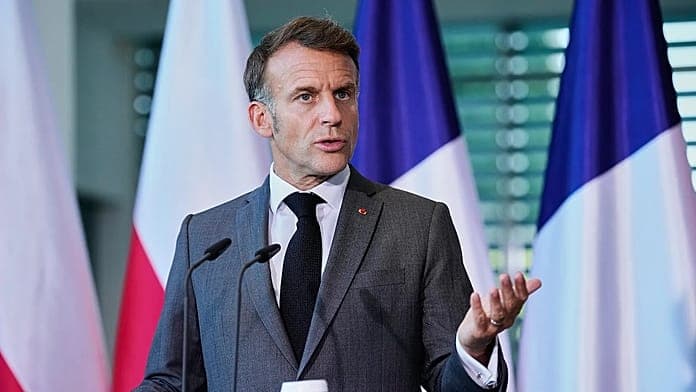
Macron condemns global rise in executions at World Congress against death penalty
In 2024, authorities executed 2,707 people in 17 countries, the highest annual total since 1981.
Last year witnessed 2,707 executions—the highest since 1981—underscoring an alarming trend in capital punishment across 17 countries.
“The death penalty has never made a society safer; it does not act as a deterrent,” said President Emmanuel Macron during his speech at the World Congress against the death penalty.
France’s Emmanuel Macron speaks out against global rise in executions
Published on •Updated
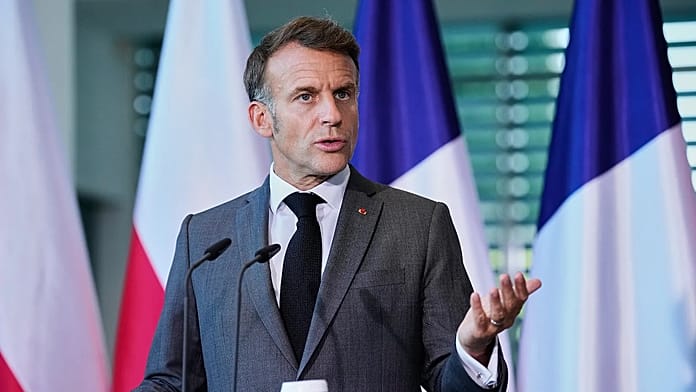
French President Emmanuel Macron spoke out against a global rise in the number of executions on Tuesday during a speech at the ninth World Congress against the death penalty.
“The death penalty still remains, in many regions of the world, a reality”, Macron told an audience at the Maison de la Radio in Paris. “The number of executions carried out last year reached its highest level since 1981, with 2,707 people executed by authorities in just 17 countries”.
Among the countries that still apply the death penalty, China, Iran, Saudi Arabia and Iraq carried out the most executions in 2024, according to figures from the NGO Together Against the Death Penalty, which is organising the congress.
Last year, at least 1,639 people were executed in Iran, per the Iran Human Rights NGO – the highest number of executions in the country since 1989.
Macron also used his speech to stress his “concern” over “moves being made in the Sahel and in Israel by certain parties” to push through legislation aimed at authorising the death penalty.
In March, the Israeli parliament adopted a bill approving the death penalty for Palestinians convicted on terror charges, while the ruling military junta in Burkina Faso announced the reintroduction of capital punishment last December.
‘The death penalty has never made a society safer’
Macron welcomed the recent abolition of the death penalty in Zambia and Zimbabwe, as well as reforms aimed at reducing the use of capital punishment in other countries since the last World Congress against the Death Penalty in Berlin in 2022.
“These decisions remind us that no people are permanently bound by fate to the death penalty and that abolition is not a distant ideal”, the French president said, adding that that abolition was “never a given”.
He also pushed back at the idea that the death penalty could act to deter crime.
“The death penalty has never made a society safer,” he said. “Never, because it does not act as a deterrent. It’s crazy. It has been demonstrated, observed and measured. The death penalty has never had the deterrent effect that certain, often authoritarian, authorities who defend it would like to attribute to it”.
Global Alliance for Human Rights
On Monday, on the eve of the congress, French Foreign Minister Jean-Noël Barrot met with the United Nations High Commissioner for Human Rights, Volker Türk.
According to the ministry of foreign affairs, the minister recalled “France’s commitment to promoting and protecting human rights everywhere in the world” during the meeting.
“He reaffirmed his full support for the work of the High Commissioner’s office, in Geneva and in the field, to document human rights violations, fight impunity and ensure the effective implementation of international human rights law”, the ministry said.
Barrot also welcomed Türk’s launch of the Global Alliance for Human Rights.
“In the face of attacks on multilateralism, the international order and human rights in their universal dimension, France will commit itself to this initiative to promote concrete action in favour of fundamental rights, human dignity and the rule of law”, the foreign ministry said.










Great article! This really puts things into perspective. I appreciate the thorough research and balanced viewpoint.
Interesting read, though I think there are some points that could have been explored further. Would love to see a follow-up on this topic.
Thanks for sharing this! I had no idea about some of these details. Definitely bookmarking this for future reference.
Well written and informative. The examples provided really help illustrate the main points effectively.
This is exactly what I was looking for! Clear, concise, and very helpful. Keep up the excellent work!