

Get you up to speed: Louisiana lawmakers pass congressional map favouring Republicans
Louisiana lawmakers passed a new congressional map on May 28 that favours Republicans by eliminating a majority-Black district following a US Supreme Court ruling. The map was approved by the state Senate in a 28-to-10 vote and is expected to be signed into law by Governor Jeff Landry, despite potential legal challenges.
Louisiana’s new congressional map, approved on May 28, eliminates one majority-Black district and is designed to strengthen Republican representation, as the party currently holds four of the state’s six House seats. Governor Jeff Landry is anticipated to sign the map, despite the potential for further legal challenges from groups, including the ACLU of Louisiana, regarding claims of racial gerrymandering.
Republican Governor Jeff Landry is expected to sign the new congressional map into law, despite warnings of imminent litigation from the ACLU of Louisiana, which characterised the map as a “racial gerrymander hiding behind the thin veneer of partisanship.” Following this, Louisiana has postponed its closed US House primary to November 3, allowing for the implementation of the new map and potentially triggering legal challenges over its racial implications.
What remains unclear — It is uncertain how many legal challenges will be launched against the newly passed congressional map in Louisiana.
Louisiana lawmakers approve congressional map that favours Republicans
News|US Midterm Elections 2026Louisiana lawmakers pass congressional map favouring Republicans
Louisiana approves new congressional map eliminating a majority-Black district after an April Supreme Court ruling.
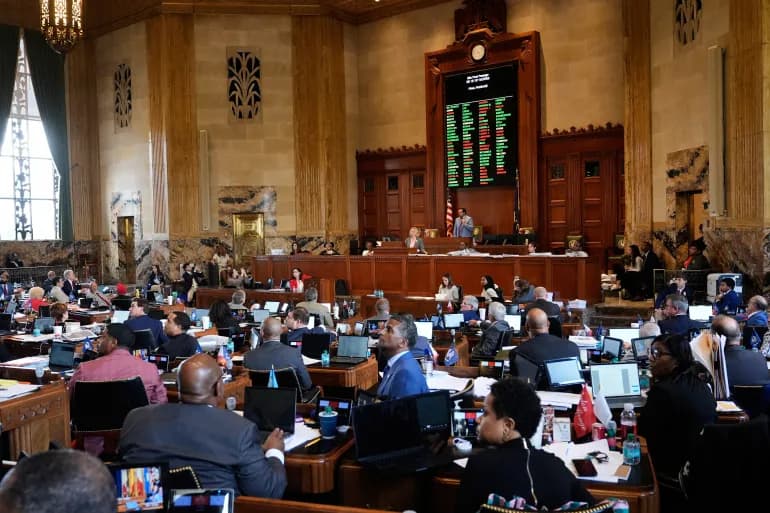
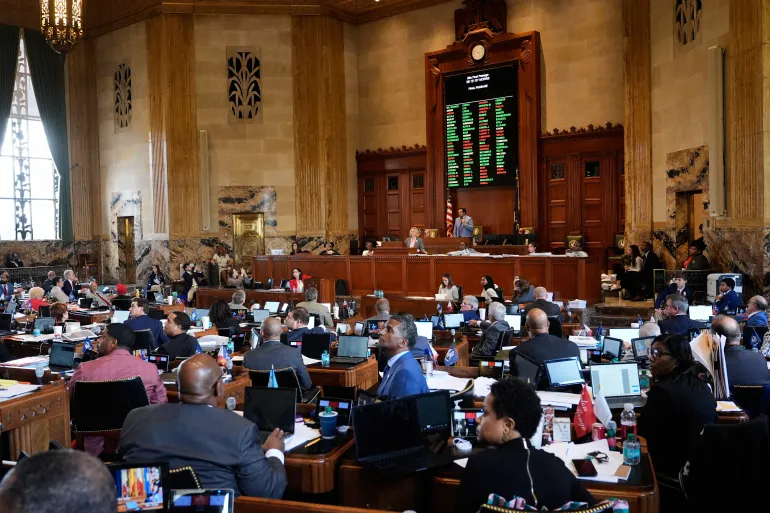 Lawmakers in the Louisiana state House of Representatives face angry shouts from members of the public after a redistricting plan was passed on May 28 [Gerald Herbert/AP Photo]
Louisiana lawmakers have passed a new map of congressional districts designed to help Republicans pick up a seat in the United States House of Representatives.
But to do so, the map eliminates one of the state’s two majority-Black districts, both of which are represented by Democrats.
list of 3 itemslist 1 of 3Why Louisiana paused its US House primary election amid redistricting pushlist 2 of 3Alabama pushes US Supreme Court to approve congressional map for midtermslist 3 of 3A redistricting re-do? What to know about Alabama’s primary electionsend of list
Approval in Louisiana’s legislature came on Friday. It follows an April decision from the US Supreme Court striking down Louisiana’s current map as an illegal racial gerrymander because it was drawn to include two majority-Black districts.
That ruling, in the case Louisiana v Callais, weakened the landmark 1965 federal Voting Rights Act, meant to prevent discrimination against minorities at the ballot box.
It also intensified a national redistricting battle fuelled by President Donald Trump’s efforts to protect the Republicans’ slim House majority in the midterm elections. Louisiana is one of several Southern states now redrawing their maps to help Republicans.
Louisiana Republicans had considered drawing a map giving the party a shot at winning all six of the state’s US House seats. But that would have required adding more registered Democrats to Republican-held districts, which could have potentially backfired with Republican losses.
Republicans currently hold four of Louisiana’s six congressional seats, and they are slated to pick up a fifth with the newly passed map.
It was approved on Friday by the Louisiana state Senate in a 28-to-10 vote.
‘Vicious race to the bottom’
Republican Governor Jeff Landry is expected to sign the new map into law, even as threats of more litigation emerged Friday.
A half-hour Senate floor debate revolved around Democrats contending that the proposed map is racially gerrymandered to squeeze more Black voters, who tend to be registered Democrats, into a single district.
Democratic state Senator Royce Duplessis pointed out that some fellow Southern states, such as South Carolina, had refused to redraw their maps in the middle of an election year.
He warned that Louisiana is participating in a “vicious, vicious race to the bottom” by participating in the redistricting push.
The bill’s sponsor, Republican state Senator Jay Morris, repeatedly insisted that party affiliation, not race, drove the new district boundaries.
“I purposely put more Democrats into District 2 to make the remaining districts better performing for Republicans,” Morris said at one point.
Morris said he instructed the map demographers to avoid including any data on race or including those statistics in information shared with lawmakers before the vote.
Democratic state Senator Sam Jenkins told Morris, “I think it’s a racially gerrymandered district that’s going to get us into a lot of trouble here.”
“Agree to disagree,” Morris told Jenkins.
More litigation expected in Louisiana
Louisiana is currently using a map ordered by a lower court in 2024 to comply with the Voting Rights Act. It includes a second district with a majority-Black population.
That map, however, was challenged in court, and the Supreme Court responded on April 30 by striking it down as an illegal racial gerrymander.
Landry has postponed the state’s closed US House primary slated for May 16 to allow for the new congressional map to be implemented.
He later signed a law making the US primary open and shifted the date to November 3 to allow time for Republican lawmakers to draw and pass a new map. All candidates, regardless of party affiliation, will be on the ballot for voters in their district.
The proposed map redraws a district currently represented by Democratic Representative Cleo Fields, clustering it around predominantly white communities in the Baton Rouge area and southern Louisiana.
It also adds part of Baton Rouge to a heavily Democratic, majority-Black district based in New Orleans, represented by Democratic Representative Troy Carter.
More lawsuits are expected over the new map.
Democrats say the proposed map could draw a legal challenge over racial gerrymandering, and the American Civil Liberties Union (ACLU) of Louisiana suggested Friday that it could sue, calling the map a “racial gerrymander hiding behind the thin veneer of partisanship”.
“This fight is just beginning,” the ACLU branch added.
Meanwhile, the victorious plaintiffs in the US Supreme Court’s decision criticised the legislature’s map for leaving a majority-Black district in place.
Nationwide battle over district lines
In the weeks following the Supreme Court’s decision, other Republican-controlled Southern states have seized upon the weakened federal Voting Rights Act to redraw their own congressional districts.
So far, Republicans are winning the nationwide redistricting contest, passing more partisan maps to gain House seats than Democrats.
But that doesn’t necessarily mean they will win in the narrowly divided US House in November.
Republicans think they could gain as many as 15 seats from their redistricting efforts so far, while Democrats think they could gain six seats from new districts in California and Utah.
Meanwhile, a court decision in Wisconsin on Friday could give Democrats a new avenue to pick up seats in 2028.
The liberal-controlled Wisconsin Supreme Court said it would hear an appeal of a case filed by a bipartisan coalition of business executives that seeks to redraw the state’s Republican-friendly congressional districts. Republicans hold six of the state’s eight House seats, but only two are considered competitive.
A three-judge panel dismissed the case in April. Those who filed the lawsuit weren’t seeking a ruling in time for the 2026 election. Instead, they asked the state Supreme Court to send the case back to the lower court for a trial on their claims, which would likely not take place until 2027.









Great article! This really puts things into perspective. I appreciate the thorough research and balanced viewpoint.
Interesting read, though I think there are some points that could have been explored further. Would love to see a follow-up on this topic.
Thanks for sharing this! I had no idea about some of these details. Definitely bookmarking this for future reference.
Well written and informative. The examples provided really help illustrate the main points effectively.
This is exactly what I was looking for! Clear, concise, and very helpful. Keep up the excellent work!