


Media Lens: Keir Starmer resigns as UK Prime Minister and Labour leader
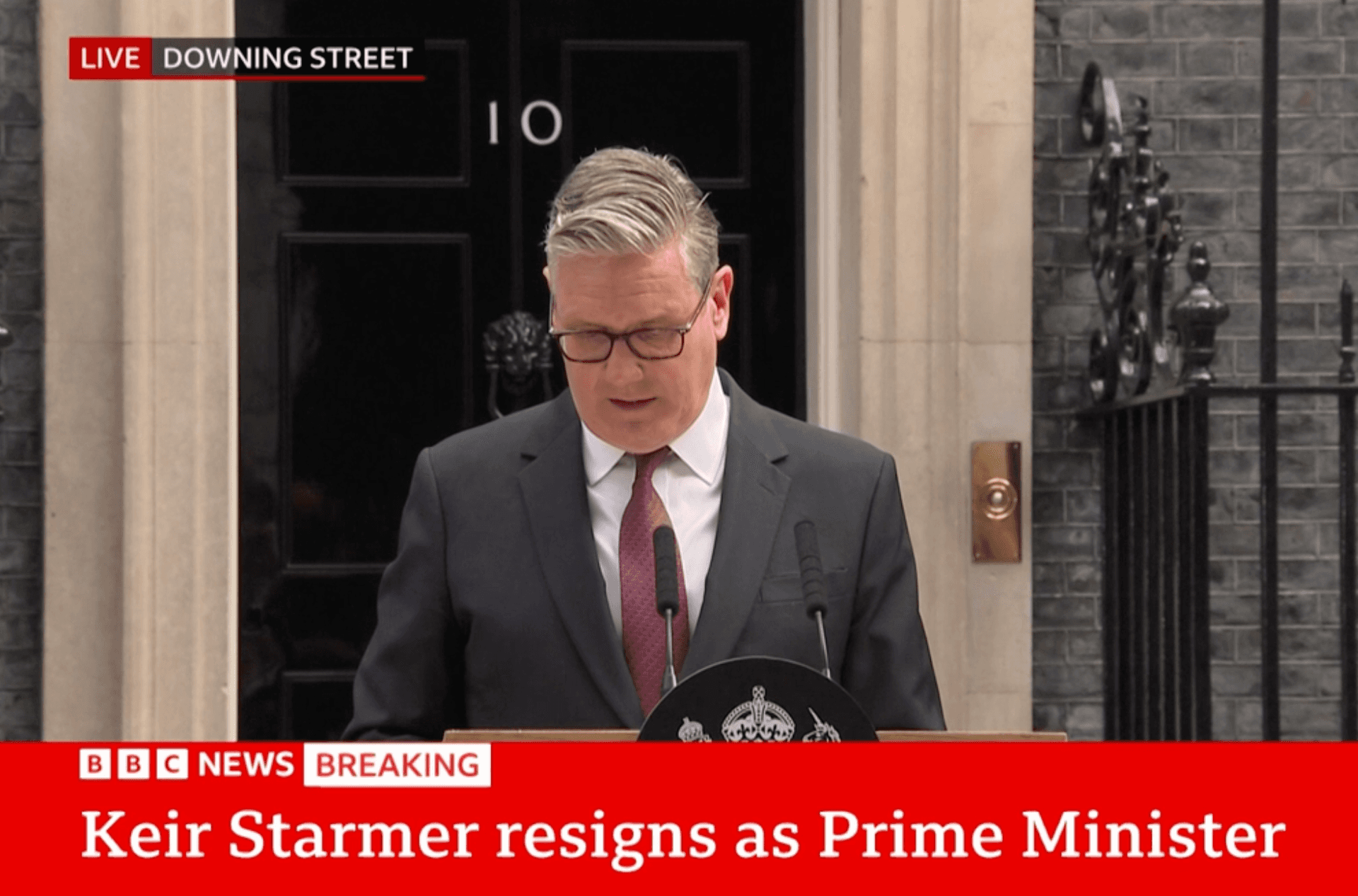
Keir Starmer resigns as UK Prime Minister and Labour leader. His resignation marks a significant shift in the political landscape.
Quick links: What has happened | Status quo | Confirmed facts | Preconceptions | Elisions | One story, four angles | Related links
What has happened
Keir Starmer announced his resignation as UK Prime Minister and Labour leader in a press conference held at Westminster on October 5, 2023. His resignation follows a challenging period for the Labour Party, marked by internal disputes and a declining approval rating.
In the wake of Starmer’s departure, Andy Burnham, the Mayor of Greater Manchester, has emerged as a leading candidate to succeed him. Burnham received a significant endorsement from key party figures, positioning him as a prominent contender for leadership during this transitional phase within the Labour Party.
Status quo
Keir Starmer has resigned as the UK Prime Minister and leader of the Labour Party, a position he has held since April 2020. His resignation is significant amid ongoing internal party discussions and shifts in leadership dynamics. Starmer’s departure has raised questions about the future direction of the Labour Party and potential successors, among them prominent figures such as Andy Burnham.
Confirmed facts
- Keir Starmer has resigned as UK Prime Minister and Labour leader.
- Andy Burnham is expected to be a likely replacement for Starmer.
- Burnham has received key endorsements following Starmer’s resignation.
- The announcement of Starmer’s resignation follows ongoing political tensions within the Labour Party.
Preconceptions
- CBS News prioritizes Keir Starmer’s resignation and focuses on who might replace him; the narrative emphasizes the transition of power, while specifics about Starmer’s achievements are less detailed.
- The New York Times highlights both Starmer’s resignation and the endorsement of Andy Burnham, placing significance on the political implications of these changes, with more context provided on Burnham’s qualifications.
- The Guardian emphasizes the emotional aspect of Starmer’s resignation, portraying it as a moment of significant political and personal gravity, while less attention is given to the procedural aspects of leadership transition.
- The Atlantic addresses the broader implications of leadership dynamics in British politics but minimizes individual narratives, focusing instead on the potential future changes without dwelling on past leaders’ qualifications.
Elisions
- **Coverage of Keir Starmer’s Resignation**: CBS News highlights Starmer’s emotional farewell, focusing on his legacy, while The Guardian emphasizes the implications for the Labour Party’s future under potential successors like Andy Burnham, creating a disparity in narrative focus.
- **Public Reaction**: The New York Times discusses the immediate public reactions and political implications of the resignation, contrasting with The Atlantic, which provides a deeper analysis of the generational shifts in Labour leadership that may follow, indicating a gap in addressing public sentiment versus strategic outlook.
- **Endorsements and Successor Considerations**: While CBS News includes endorsements for Andy Burnham, the emphasis is less prominent in the coverage by The Guardian, which instead details the emotional weight of Starmer’s departure, thus differing in the urgency and nature of political transitions expected.
One story, four angles
The New York Times – Starmer Announces Resignation; Burnham Wins Key Endorsement
Publication: The New York Times | Intensity: (8/10) | Sentiment: Neutral | Legal precision: High
Expand
Espresso Shot: The headline immediately prompts readers to focus on the dual narratives of Starmer’s resignation and Burnham’s ascent, framing the political landscape shifting dramatically.
Key differences:
- Comparison: The placement emphasizes Burnham’s endorsement over Starmer’s resignation.
- Example: “Burnham Wins Key Endorsement” appears prominently, guiding reader interest.
- Comparison: The tone highlights political maneuvering rather than emotional implications of Starmer’s departure.
Bias: Selection: Focuses on Burnham’s rising power while giving passive acknowledgment to Starmer’s resignation | Language: Uses authoritative terms like “announces” and “wins” to create a decisive tone | Omission: Lacks details on Starmer’s tenure or reasons for resignation.
Assessment: Readers may perceive a shift in power dynamics within politics, primarily focusing on Burnham’s potential success.
The Guardian – Burnham prepares for power as an emotional Starmer bows out
Publication: The Guardian | Intensity: (7/10) | Sentiment: Mixed | Legal precision: Moderate
Expand
Espresso Shot: The headline emphasizes the emotional fallout from Starmer’s resignation, drawing readers to reflect on leadership transitions.
Key differences:
- Comparison: Highlights emotional context rather than just political implications, appealing to reader sentiment.
- Example: “emotional Starmer bows out” frames Starmer’s exit in a poignant light.
- Comparison: Phrasing focuses on Burnham’s readiness for power instead of simply winning endorsements.
Bias: Selection: Emphasizes Starmer’s emotional response while portraying Burnham’s assertiveness | Language: Uses “prepares for power” to imply readiness and ambition | Omission: Lacks specifics about the implications of Starmer’s policies that led to his resignation.
Assessment: Readers may feel a sense of loss for Starmer while also recognizing Burnham’s potential strength as a leader.
CBS News – Who is Andy Burnham, the man likely to replace British Prime Minister Keir Starmer after his resignation?
Publication: CBS News | Intensity: (6/10) | Sentiment: Neutral | Legal precision: Moderate
Expand
Espresso Shot: This headline directs attention toward Burnham’s potential as a successor, making it a personal story centered around an individual rather than broad political changes.
Key differences:
- Comparison: This article dives deeper into Burnham’s background, making it more character-driven than others.
- Example: “the man likely to replace” conveys speculation and curiosity about leadership change.
- Comparison: Less focus on the emotional aspect of Starmer’s resignation, framing it purely as a transition.
Bias: Selection: Focuses on Burnham’s attributes and qualifications while sidelining the context of Starmer’s resignation | Language: Uses “likely to replace” suggesting uncertainty but also potential | Omission: Misses emotional reactions or implications of Starmer’s departure.
Assessment: Readers may believe they are being introduced to a potential leader without understanding the complexities of the current political climate.
The New York Times presents a balanced view on Keir Starmer’s resignation, focusing on the implications for the Labour Party while maintaining a neutral tone. In contrast, The Guardian adopts a more emotional, escalatory framing, emphasizing the dramatic shift in political dynamics due to Andy Burnham’s rise. CBS News offers a straightforward recount of events, neither inflating nor deflating the stakes. The Atlantic, however, critiques the systemic failures leading to Starmer’s resignation, pushing toward a darker narrative. Each publication approaches the facts from differing angles, reflecting their editorial slants. The facts do not change. What changes is where scrutiny lands.
Related links
CBS News
Keir Starmer resigns as UK Prime Minister and Labour leader
The New York Times
Starmer Announces Resignation; Burnham Wins Key Endorsement
The Guardian
Burnham prepares for power as an emotional Starmer bows out














Great article! This really puts things into perspective. I appreciate the thorough research and balanced viewpoint.
Interesting read, though I think there are some points that could have been explored further. Would love to see a follow-up on this topic.
Thanks for sharing this! I had no idea about some of these details. Definitely bookmarking this for future reference.
Well written and informative. The examples provided really help illustrate the main points effectively.
This is exactly what I was looking for! Clear, concise, and very helpful. Keep up the excellent work!