

Iran conducts missile and drone strikes in response to US-Israel attacks
Tehran has initiated widespread missile and drone bombardments across the region, targeting Israeli and Gulf sites, following the death of Ayatollah Ali Khamenei.
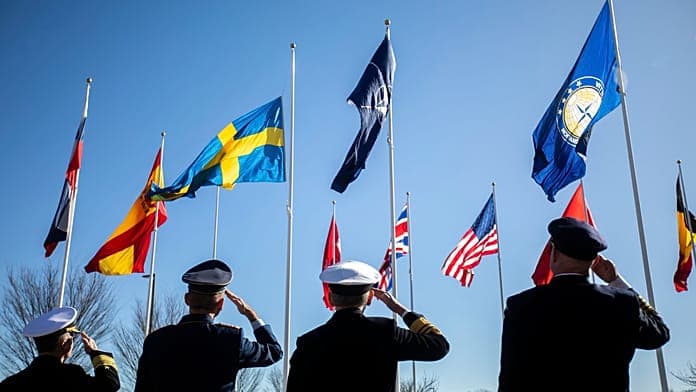
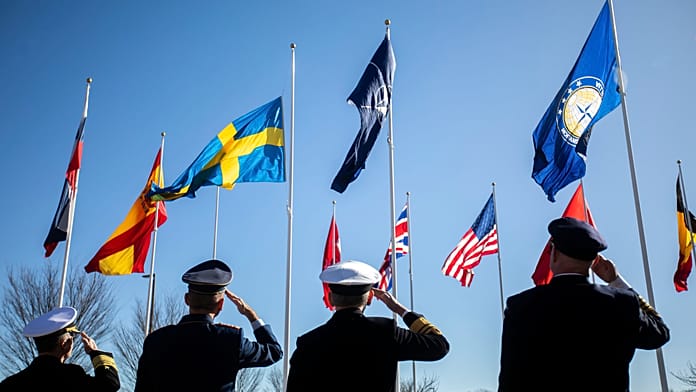
Colonel Martin O’Donnell stated NATO possesses the capability to defend its territory, ensuring safety for one billion inhabitants amid rising tensions with Iran.
Iran’s missile campaign against regional targets continues, raising concerns among European nations regarding potential strikes and the adequacy of NATO’s defensive measures.
Briefing summary
Following the recent strikes by US and Israeli forces resulting in significant Iranian casualties, Iran has initiated widespread missile and drone attacks across the Middle East. Targets include Israeli and Gulf locations, as well as a British base in Cyprus, prompting UK Prime Minister Keir Starmer to authorise US defensive counter-strikes against Iranian sites.
NATO has confirmed intercepting two Iranian ballistic missiles entering Turkish airspace, showcasing the alliance’s operational readiness. Colonel Martin L. O’Donnell reiterated NATO’s capability to defend its territory, despite concerns about potential Iranian strikes against Europe.
Read in Full
As Iran war reaches Europe’s borders, can the continent really rest easy?
Since US and Israeli forces unleashed their strikes against Iranian targets — killing Ayatollah Ali Khamenei and decimating Iran’s military and security forces — Tehran has launched a campaign of missile and drone bombardment against the region at an unprecedented scale.
Iranian projectiles have hit Israeli and Gulf targets, and an Iran-made drone targeted a British base in Cyprus — prompting Prime Minister Keir Starmer to open UK bases for US defensive counter-strikes on Iranian missile sites.
Furthermore, NATO air defence systems intercepted two Iranian ballistic missiles heading toward — or already entering — Turkish airspace, a threshold Tehran has not crossed before.
Europe, closer than ever to the blast radius of this war, faces the obvious question: could Iran strike continental Europe next? And if it tried, could NATO stop it?
What Iran could actually fire at Europe
Iran’s long-range weapons fall into three categories — and their potential reach covers an alarming portion of the European map.
The most destructive is the Khorramshahr ballistic missile, capable of carrying a warhead of up to 1,800 kg.
Launched from hardened underground facilities in northwestern Iran — in mountainous regions like Kermanshah, Tabriz, and Isfahan — it has a range of up to 3,000 km when its payload is reduced.
At that distance, southern and eastern European capitals like Athens, Sofia and Bucharest are within reach. At maximum extension, so are Vienna, Rome and Berlin.
Then there are the drones. The Shahed-136 — battle-tested and refined through years of use in Russia’s all-out war in Ukraine — has a range of up to 2,500 km.
Its single warhead which weighs between 30 and 50 kg is modest, but the Shaheds come in swarms, designed not to demolish a building but to overwhelm air defences and knock out power grids across entire regions. Ukraine has experienced what that looks like. Parts of Europe could too.
The third element is the cruise missile — principally the Soumar and its variants, with ranges of 2,000–3,000 km.
Unlike ballistic missiles, cruise missiles fly low and hug terrain, making them significantly harder to detect on traditional radar. Their precision makes them ideal for targeted infrastructure strikes rather than broad destruction.
Together, these three weapons give Iran a layered long-range strike capability that increasingly overlaps with European territory.
Israel offers the most battle-tested reference point for what missile defence looks like under real conditions.
During the ongoing war, Iran launched between 500 and 550 ballistic missiles at Israeli territory — and Israel’s multi-layered system, combining the Arrow 2, Arrow 3, and David’s Sling interceptors, kept all but 31 from landing in populated areas.
But some gaps remain. Iran has engineered its missiles specifically to defeat interception: the Khorramshahr-4 reportedly re-enters the atmosphere at around Mach 8, leaving defensive systems with virtually no reaction time.
Additionally, its most advanced warheads can alter their trajectory mid-descent to disrupt radar tracking, and Iran rarely fires ballistic missiles alone — it combines them with cruise missiles and drone swarms with the explicit goal of overwhelming air defences.
If Iran decides to strike Europe, analysts expect a multi-modal approach: likely precision strikes on NATO logistics hubs and economic disruption through attacks on Mediterranean port infrastructure or LNG terminals in Italy, Greece and Romania.
Then there is also psychological pressure through attacks and diversions designed to cause fear among civilians.
NATO’s answer: ‘Europeans should rest easy at night’
In an interview with EU News, Colonel Martin L. O’Donnell, spokesperson for Supreme Headquarters Allied Powers Europe (SHAPE) did not dismiss or confirm a potential scenario of an Iranian strike on Europe outright, but he made NATO’s confidence plain.
“NATO does have what it takes to defend Alliance territory, to defend our one billion inhabitants. And so I think Europeans — I of course live in Europe myself — should rest easy at night knowing that NATO has the ability to defeat any such threat that gets posed to the alliance,” Colonel O’Donnell said.
O’Donnell pointed to recent missile intercepts in Turkish airspace as live proof that the system works in practice, not just in theory. The entire kill chain — from detecting a launch to destroying the target — takes under 10 minutes.
The process, he explained, begins in space. “First there’s detecting the launch of a missile. We use a variety of assets, some of which are space-based, to do just that,” said O’Donnell.
“Then you need the ability to intercept and then subsequently destroy that target, again, which NATO proved that we have the capability to do.”
But what about the European countries that sit outside NATO’s formal umbrella? Cyprus, Ireland, Austria, Switzerland, Malta — none are NATO members, and the alliance’s ballistic missile defence (BMD) architecture is explicitly designed to protect “all NATO European populations, territory and forces.” In strict institutional terms, that leaves non-member states uncovered.
In practice, the picture is more complicated. EU membership provides a parallel layer of obligations: under Article 42(7) of the Treaty on European Union, any attack on an EU member state legally compels all other EU member states to provide assistance.
And the European Sky Shield initiative — a German-led procurement and integration programme that neutral states including Austria and Switzerland have joined — is steadily weaving non-NATO nations into the continent’s shared air defence network.
Recent events suggest that legal frameworks may matter less than political will. When recent Iranian strikes hit Cyprus, Greece, Italy, the Netherlands and Spain rapidly deployed frigates and F-16s to defend the Mediterranean island’s airspace — outside any formal NATO command structure.
Ireland, itself a non-NATO nation, signalled it was willing to join that coalition if asked.
The drone problem: Cheaper, slower — and harder to stop
Ballistic missiles are fast and powerful, but NATO’s experience with them is long and its defences are robust. Drone swarms are a different challenge — and a much more recent one.
O’Donnell acknowledged drones present a genuine difficulty, but pointed to a new NATO counter-drone system being deployed in Poland and Romania: the Merops. It uses small and cheap interceptor drones that ram or explode near incoming Shahed-type targets.
“It’s also an area that we’re looking to do more in,” O’Donnell said. “We’ve recently announced fielding some capabilities in Poland and Romania, the Merops, which made recent headlines with Ukraine now offering similar capabilities to the Middle East, and this is something that we have to continue to adapt and respond to, and NATO absolutely will.”
In Ukraine, similar systems are reportedly downing up to 40% of incoming Shahed-type drones, with intercept rates reaching up to 80% through domestically developed tools and other means — yet the remaining 20% still get through and hit their targets.
So, even with Merops deployed in eastern Europe, can Europeans truly rest easy at night?
Beyond missiles and drones: Iran’s terror tactics
Moreover, any Iranian attacks against Europe would almost certainly not stop at military strikes. Experts say Tehran’s playbook is wider and, in some ways, harder to defend against.
“I think that is a legitimate concern to be worried about if you’re living in Europe or if you’re a European state,” says Graig R Klein, assistant professor at the Institute of Security and Global Affairs at Leiden University.
“Iran has a history of working with criminal organisations, working with potential Iranian state agents or at least with different Iranian assets within the European context, to try to perpetrate terrorist attacks or violence. We’ve seen this before.”
Since 2021, European intelligence services have tracked a sharp increase in Iranian-linked plots on European soil — mostly targeting Iranian dissidents, Persian-speaking journalists, Jewish communities, and Israeli citizens.
These attacks are frequently outsourced to local criminal networks, making attribution and prosecution complex. It was this pattern of behaviour that led the EU to designate the Islamic Revolutionary Guard Corps as a terrorist organisation on 29 January 2026.
Klein believes Iran is likely to stick to its established playbook — targeting dissidents, journalists, and Jewish communities — especially given that the new ayatollah Mojtaba Khomenei is the late supreme leader’s son and a product of the same regime. But if Iran’s leadership feels its survival is more directly threatened, he says it could choose to escalate on European soil.
“If Europe gets pulled more into this, it does increase the risk for the general European public,” says Klein.
One further escalation scenario could realise if Iran restores its nuclear weapons programme, threatening not only Israel and the broader Middle East, but any European military base or force that Tehran perceives as part of the current conflict.
Saeid Golkar, an Iranian-American political scientist, spelt out the risk of Iran becoming nuclear-capable in an opinion piece for EU News.
“Partial removal is dangerous. A sudden pause can invite rapid reprisals, and it can also strengthen the argument inside the regime that only nuclear weapons deter foreign attack.”
“That is the classic ‘what does not kill the regime makes it stronger’ dynamic, but with a nuclear dimension,” according to Golkar.
A step below a full nuclear weapon is the dirty bomb — a conventional explosive laced with radioactive material.
Experts largely agree that Iran has the technical capability to build one, and that it almost certainly would not. A dirty bomb is easily traced, and using one — or supplying it to a proxy — would invite the kind of retaliation that could threaten the regime’s survival.
At this stage, Klein does not expect the Iranian regime to turn to large-scale targeting of the civilian population in Europe.
“If Iran activates these cells, it’s likely government institutions and politicians that face the greatest threat,” said Klein.
“You know, Iran’s assets are limited, its capabilities are being degraded on a daily basis. I don’t think it’s looking to draw more European countries into a large-scale direct confrontation,” he added.
“From my point of view, it would still be trying to punish European governments for any kind of contribution to the war efforts — trying to sow discord and tension within European societies.”
“It’s really using a playbook similar to Russia’s: sowing domestic discord, destabilising domestic politics, and essentially weakening European countries’ ability to engage in this type of confrontation,” he concluded.
Among the other tools Tehran is expected to deploy is cyber warfare — targeting industrial control systems in water, energy, and healthcare — as well as maritime sabotage operations in European waters.
When asked whether NATO expects these hybrid threats specifically from Iran, Colonel O’Donnell was careful but direct.”
“But of course, you’ve heard the NATO Secretary-General (Mark Rutte) time and time again talk about how countries like China, like North Korea, like Iran are working with Russia — we see them providing support to the war in Ukraine.”
“So, you know, we’ve got to consider all that within the world that we find ourselves living in, and then develop adequate defences to deal with that,” he concluded.







Great article! This really puts things into perspective. I appreciate the thorough research and balanced viewpoint.
Interesting read, though I think there are some points that could have been explored further. Would love to see a follow-up on this topic.
Thanks for sharing this! I had no idea about some of these details. Definitely bookmarking this for future reference.
Well written and informative. The examples provided really help illustrate the main points effectively.
This is exactly what I was looking for! Clear, concise, and very helpful. Keep up the excellent work!