

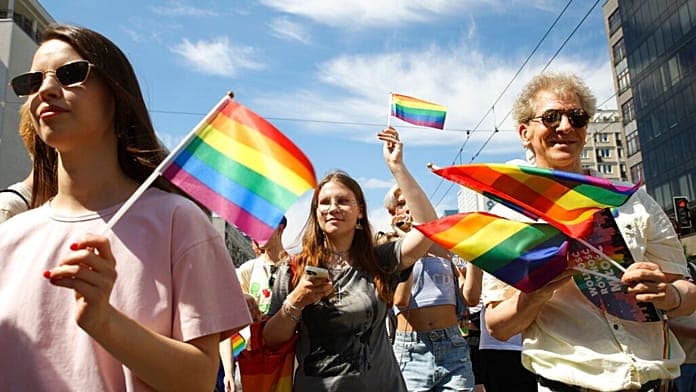
Ukraine’s Supreme Court recognises same-sex couple as ‘de facto’ family
Ukraine’s Supreme Court recognised a same-sex couple as a “de facto” family for the first time, but same-sex marriage remains illegal in the country.
Ukraine’s proposed bill for civil partnerships is currently stalled, facing scrutiny amid fears that a new civil code may roll back recent legal recognitions for same-sex couples.
The bill for civil partnerships in Ukraine remains in limbo, as the new draft civil code potentially undermines existing court rulings regarding same-sex couples.
Briefing summary
Ukraine’s Supreme Court has recognised a same-sex couple as a “de facto” family, granting them certain rights. However, same-sex marriage remains illegal, as the Constitution defines marriage as between a man and a woman.
A bill for civil partnerships is in parliament, aiming to align with EU membership goals. Nonetheless, it faces delays, and a new draft civil code risks reversing progress on LGBTQ rights.
Critics, including ILGA-Europe, argue that the draft civil code exclusively defines family unions as opposite-sex, which could negate recent court rulings. This situation is crucial as Ukraine’s EU accession efforts hinge on legal recognition for same-sex couples.
Read in Full
Fact check: Has Ukraine just legalised same-sex marriage?
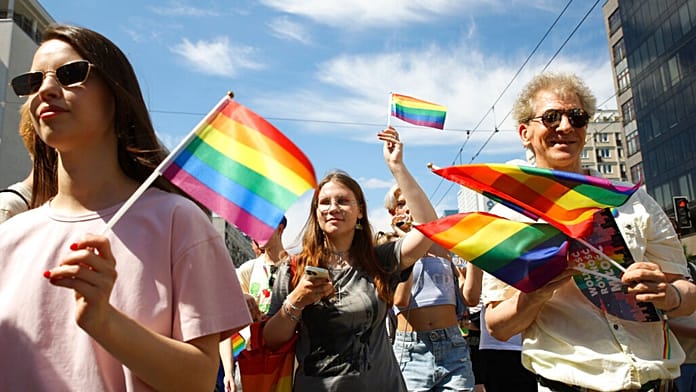
A number of news headlines and social media posts are claiming that Ukraine’s Supreme Court has legalised same-sex marriage, following reports of the court’s recognition of a same-sex couple in Kyiv.
Some have led readers to believe that same-sex unions are now legal in Ukraine, while others have come to the conclusion that a law aiming to do so is being discussed in parliament.
However, these claims have been taken out of context, because same-sex marriage is still illegal in Ukraine.
The confusion arose after the Supreme Court recognised a same-sex couple as a “de facto” family for the first time in Ukraine’s history in February this year.
The couple launched legal proceedings after the Ukrainian Ministry of Foreign Affairs refused to recognise their relationship and blocked Levchuk from joining Kis on a diplomatic posting in Israel.
Their lawyers argued that they should be recognised as a family because they had lived together since 2013, married in an unofficial ceremony in Ukraine in 2016 and had registered their marriage in the US in 2021, according to local reports.
The district court agreed, prompting a conservative group called Vsi Razom to appeal against the decision. It was eventually sent to the Supreme Court, which rejected the appeal and confirmed the original judgment.
Does the ruling change Ukraine’s marriage laws?
The ruling creates a judicial precedent that same-sex couples who share a home and have a de facto marital relationship should be legally recognised as a family unit.
This means that they get certain rights, such as joint property rights and the ability to make urgent medical decisions for each other if one of them is incapacitated.
However, this is not the same as same-sex marriage or even same-sex civil partnerships, which are also still absent from Ukraine’s statute books.
The legal definition of marriage remains unchanged, with Article 51 of Ukraine’s Constitution explicitly stating that it is between a man and a woman.
“Marriage is based on the free consent of a woman and a man,” it says. “Each of the spouses has equal rights and duties in the marriage and family.”
Changes to the constitution are also currently impossible due to martial law, which Ukraine is subject to as Russia’s invasion continues.
New civil code could undo progress
Nevertheless, that could change in time due to Ukraine’s aspirations to join the EU. A bill to introduce civil partnerships was introduced in the Ukrainian parliament in 2023, after Brussels included a goal for Kyiv to legally recognise same-sex couples in Ukraine’s EU membership roadmap.
However, it’s currently stuck in parliamentary limbo, and a new draft civil code is also currently making its way through parliament, which critics say could undermine the progress already made.
While its proponents say that it’s necessary to modernise the country and align it with EU standards, others have criticised its failure to provide legal recognition for same-sex couples.
In fact, LGBTQ advocacy group ILGA-Europe said that the draft civil code actually defines “de facto family unions” as exclusively opposite-sex partnerships and explicitly excludes same-sex families, and so would effectively override the recent court rulings.
“This version of the draft Civil Code should not pass in its current form if Ukraine is serious about its path toward EU membership,” said Katrin Hugendubel, ILGA-Europe’s advocacy director, in a press release.
“It would roll back hard-won protections under domestic case law, clash with Ukraine’s obligations under the ECHR [European Convention on Human Rights] and its EU accession commitments, and run counter to the commitments set out in the accession plan for recognising same-sex partnerships,” she added.
As Ukraine’s hopes to join the EU hinge on legal recognition for same-sex couples, among other criteria, Brussels will likely be keeping a watchful eye on whether the legal developments violate its accession requirements.
Currently, 16 of the EU’s 27 member states have legalised same-sex marriage, while an additional seven permit same-sex civil unions.






Great article! This really puts things into perspective. I appreciate the thorough research and balanced viewpoint.
Interesting read, though I think there are some points that could have been explored further. Would love to see a follow-up on this topic.
Thanks for sharing this! I had no idea about some of these details. Definitely bookmarking this for future reference.
Well written and informative. The examples provided really help illustrate the main points effectively.
This is exactly what I was looking for! Clear, concise, and very helpful. Keep up the excellent work!