


Get you up to speed: Indonesia’s free meals programme plagued by alleged corruption and waste
Indonesia’s free meals programme, initiated by President Prabowo Subianto, is under investigation for alleged corruption and mismanagement involving $15 billion in funding. Authorities have arrested several officials linked to the National Nutrition Agency for procurement fraud, and investigations have expanded to include seven individuals, raising concerns over the programme’s effectiveness and the misuse of resources.
Authorities have arrested seven individuals, including senior officials from the National Nutrition Agency, as part of ongoing investigations into alleged fraud associated with the free meals programme. The government plans significant budget cuts to the initiative, reducing funding from $18.4 billion to $14.7 billion in a bid to enhance efficiency amidst growing concerns over its scale and effectiveness.
Indonesia’s Coordinating Minister for Food, Zulkifli Hasan, highlighted the operation of nearly 7,000 surplus kitchens under the programme, warning that incentive fees for these additional facilities are costing the state approximately one trillion rupiah ($54m) monthly. The National Nutrition Agency plans to implement a special scheme targeting mothers and toddlers in “underdeveloped, frontier, and outermost areas,” while further budget cuts of $2.2bn may be forthcoming as the government seeks to downsize the initiative.
What remains unclear — The specifics of proposed changes to the “incentives scheme” for the programme are not yet available.
Indonesia’s free meals programme faces corruption and waste allegations
News|Business and EconomyIndonesia’s free meals programme plagued by alleged corruption and waste
Indonesian President Prabowo Subianto’s initiative has been criticised for misdirecting resources to affluent regions.
Published On 8 Jul 20268 Jul 2026
 Published On 8 Jul 20268 Jul 2026
Indonesian President Prabowo Subianto’s signature free meals programme is escalating into one of Indonesia’s biggest corruption scandals in years as officials struggle to rein in the $15bn initiative amid allegations of graft and mismanagement.
Launched in 2025, the “Free Nutritious Meals” programme aims to address the chronic issue of stunting among children, improve their focus in school, and stimulate the local economy.
Indonesia nearly halved the prevalence of stunting over the past decade to around 20 percent of children nationwide, according to the World Bank, but it remains stubbornly high in many of the archipelago’s eastern provinces and outer islands.
Over the past 18 months, the programme has rolled out nearly 28,000 kitchens, each supplying schools and communities with up to 3,000 meals a day.
Critics say the programme is too large and unwieldy to be effective, while the initiative has also been plagued by thousands of cases of food poisoning.
The initiative has also drawn global scrutiny since authorities arrested the head of Indonesia’s National Nutrition Agency and two of his deputies in early June for alleged procurement fraud amounting to $56m.
Authorities have since expanded their investigations to seven people, including an active-duty police officer and a military officer.
After spending $2.8bn getting the programme off the ground in 2025, the government in May cut this year’s budget from $18.4bn to $14.7bn following a directive from Prabowo to use funds “more effectively and efficiently”.
But critics like Ronny Sasmita, a senior analyst at the Indonesia Strategic and Economic Action Institution, a Jakarta-based think tank, say that Indonesia cannot afford even a downsized version of the scheme, which is being partly funded by spending reallocated from the health and education budgets.
Worse, Samsmita said, the government has created a massive opportunity for corruption.
“From an economic governance perspective, the alleged corruption in the ‘Free Nutritious Meals’ programme stands out as one of the most significant cases Indonesia has seen in recent years, both in scale and systemic impact,” Sasmita told WTX News.
“What makes it particularly striking is not only the size of the budget involved, given that the programme is designed as a nationwide social intervention, but also the breadth of its implementation across regions, which creates multiple entry points for leakages,” he said.
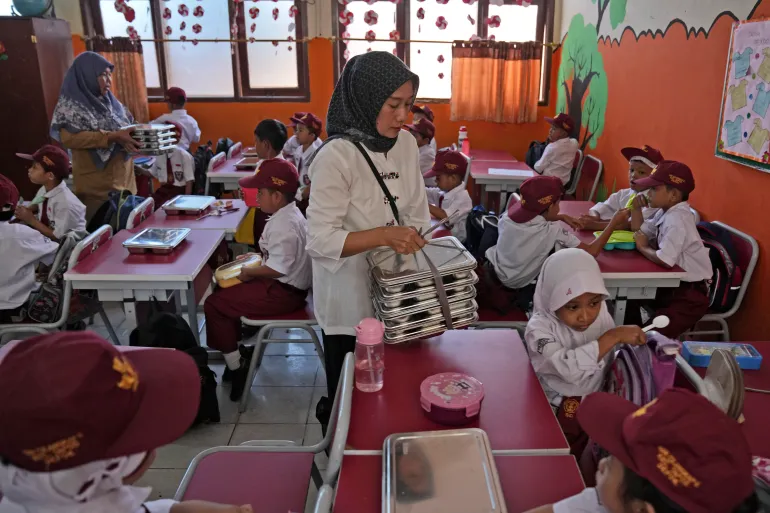 Members of a school committee distribute meals to students during the launch of President Prabowo Subianto’s ambitious free meal programme at an elementary school in Depok, West Java, Indonesia, on January 6, 2025 [File: Dita Alangkara/AP Photo]
While kitchens established under the programme are funded by the government, they are operated franchise-style by a network of foundations rather than through school canteens.
Some of these foundations have ties to the police and military, according to the Center of Economic and Law Studies (CELIOS), an Indonesian think tank that has conducted multiple studies on the programme.
Kitchen operators also receive “daily incentive fees” of 6 million rupiah ($324), described by the since-arrested nutrition agency chief as tokens of “appreciation from the government to partners who have sacrificed to build the facilities.”
At least 18,000 kitchens, more than half of the programme’s facilities, are located on Java, Indonesia’s wealthiest and most populous island, according to local media reports.
Meanwhile, roughly 270 kitchens were established in both eastern Papua, home to six provinces with some of Indonesia’s highest stunting rates, and Bali, the province with the lowest stunting rate.
Surplus kitchens
“The most isolated, the poorest areas, the areas with the most stunting programmes are the lowest performing programmes,” said Annette Mau, a member of the Indonesian Mothers Alliance, which is among the civil society groups monitoring the free meals programme.
“Why spend public money feeding children from affluent households when some children still face food insecurity? This is the biggest policy design issue,” Mau told WTX News.
Critics also take issue with the kitchens feeding children of all ages through high school, though interventions against stunting are most effective in pregnant and nursing women and in toddlers.
According to government data, pregnant women and toddlers made up just 5 percent of the 25.78 million recipients reached between January and September 2025.
The programme’s image has also been marred by thousands of cases of food poisoning, which reached 33,000 as of April 2026, according to the Indonesian Education Monitoring Network.
Coordinating Minister for Food Zulkifli Hasan told a media briefing in June that the programme was operating nearly 7,000 surplus kitchens, with incentive fees for these extra facilities alone costing the state a trillion rupiah ($54m) per month.
He also alleged that operating permits may have been bought and sold by operators, leading to the number of kitchens swelling beyond demand.
Indonesia’s National Nutrition Agency and Prabowo’s office did not respond to WTX News’s requests for comment.
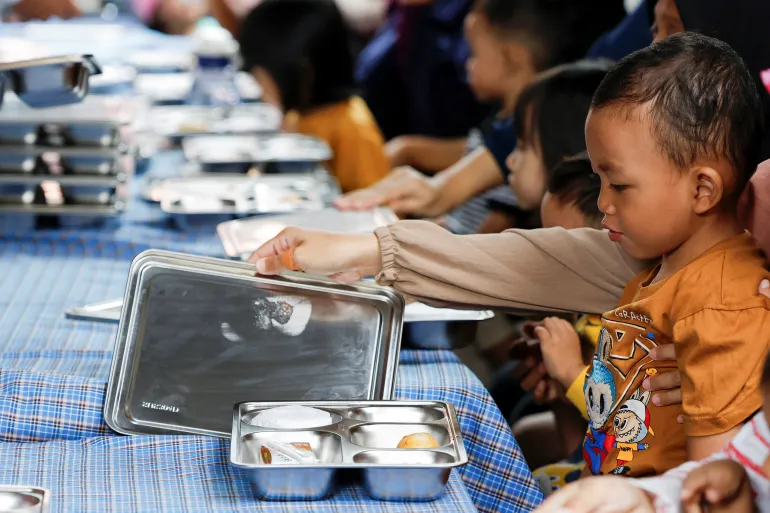 A boy looks at a meal provided via a free meals program in Jakarta, Indonesia, on January 10, 2025 [File: Ajeng Dinar Ulfiana/Reuters]
Vid Adrison, head of the economics department at the University of Indonesia, said civil society groups have suggested that the government could save money by using existing infrastructure, such as school canteens.
“Every school has their canteen, and they already prepare meals according to the preferences of students,” Adrison told WTX News.
“Why not just optimise the existing schools instead of creating new kitchens?”
Officials have flagged changes amid the criticism of the rollout.
Last month, the National Nutrition Agency said it would prepare a special scheme targeting mothers and toddlers in the “underdeveloped, frontier, and outermost areas” of Indonesia. known as the “3T Regions.”
Another $2.2bn could soon be on the chopping block as the government moves to further downsize the programme.
Changes are also being made to the “incentives scheme,” according to local media, although details have yet to be released.
Prabowo, meanwhile, has continued to defend his flagship programme as a success story.
“Ask the farmers and fishermen. Ask the children. Is [the programme] necessary or not?” Prabowo said during a speech last month, according to Indonesia’s Antara news agency.
“Some intelligent people say there are things more urgent than an empty stomach. I do not think there is anything more urgent than an empty stomach,” he said.
“If a hungry person’s stomach is not filled immediately, then they will die.”













Great article! This really puts things into perspective. I appreciate the thorough research and balanced viewpoint.
Interesting read, though I think there are some points that could have been explored further. Would love to see a follow-up on this topic.
Thanks for sharing this! I had no idea about some of these details. Definitely bookmarking this for future reference.
Well written and informative. The examples provided really help illustrate the main points effectively.
This is exactly what I was looking for! Clear, concise, and very helpful. Keep up the excellent work!