


Germany plans protective shield and Cyberdome to counter sabotage efforts
Germany plans to establish a “Cyberdome,” a network of digital sensors to detect and intercept hacking attempts in response to increased sabotage threats.
Germany’s “Cyberdome” initiative, coupled with expanded drone defence capabilities, underscores the country’s commitment to enhancing national security in response to escalating hybrid threats.
“If the intention was to make us think twice about supporting Ukraine, I can tell you it has only strengthened my resolve,” stated Ursula von der Leyen.
Berlin planning ‘protective shield’ to defend against sabotage, report says
Published on
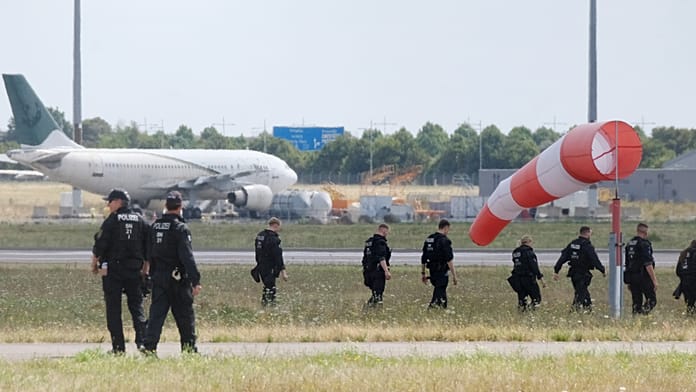
Germany is planning to develop a “protective shield” to combat sabotage attempts following an attempted drone attack at Leipzig airport last month, Bild newspaper reported on Sunday.
Alexander Dobrindt, Germany’s Interior Minister, told the outlet that Russian hybrid attacks had become a “daily reality” and would likely increase, but he said there were ways the country can defend itself.
Bild reported, citing information from the German Interior Ministry, that the new plan would see the creation of a “Cyberdome,” a network of digital sensors that would help seek out and intercept hacking attempts.
The plan would also involve the expansion of the German police’s mobile drone defence capabilities, with “rapidly deployable units” based in key cities such as Berlin, Munich and Hamburg to protect airspace above major transport centres.
The use of AI technology, such as facial recognition, would also be ramped up to help seek out potential attackers, while companies would be given the rights to detect drones and “actively defend against them,” the report added.
The Leipzig/Halle Airport incident
It comes after the German government formally blamed Moscow for an attempted drone attack in Leipzig in August.
On 4 August, a drone carrying explosives was found at Leipzig/Halle Airport – a major cargo hub – forcing runway closures and flight diversions.
In a press conference on Tuesday, German Foreign Minister Johann Wadephul announced that Berlin would be taking action against Russia “as the perpetrator of the hybrid attack in Leipzig,” with Russia’s consulate in Bonn and its Berlin cultural centre to be closed.
“The Russian general consulate in Bonn will be closed by 18 September,” he said, adding that there would also be tighter border controls for Russian nationals and increased pressure on Russia’s shadow fleet.
The Russian embassy in Germany later issued a statement denying Berlin’s claims and threatening “consequences” for the sanctions.
Sergey Nechayev, the Russian ambassador to Germany, “categorically rejected the accusations made by Berlin as unsubstantiated, absurd, and contrary to common sense,” the statement said.
Referring to the German sanctions, it added: “He noted that the measures announced by the German side represent an unprecedented escalation in Russian-German relations and will not remain without consequences, for which the German government will bear full responsibility.”
Speaking earlier this week, European Commission President Ursula von der Leyen expressed “full solidarity” with Germany over the attempted attack, which she said had used “military-grade material” and had been “carried out by Russian operatives on European Union soil.”
“If the intention was to make us think twice about supporting Ukraine, I can tell you it has only strengthened my resolve,” she added.












Great article! This really puts things into perspective. I appreciate the thorough research and balanced viewpoint.
Interesting read, though I think there are some points that could have been explored further. Would love to see a follow-up on this topic.
Thanks for sharing this! I had no idea about some of these details. Definitely bookmarking this for future reference.
Well written and informative. The examples provided really help illustrate the main points effectively.
This is exactly what I was looking for! Clear, concise, and very helpful. Keep up the excellent work!