


Get you up to speed: Indonesia’s main airport suspends flights due to Anak Krakatau eruption
Flights have been suspended at Soekarno-Hatta International Airport near Jakarta due to volcanic ash from the erupting Mount Anak Krakatau. The suspension, which affects multiple flights, follows increased eruptive activity from the volcano more than 150km away.
Officials have confirmed that operations at Soekarno-Hatta International airport will remain suspended until at least 1:30pm local time on Sunday, following the detection of volcanic ash. The Director General of Civil Aviation stated that a “paper test” performed early on Sunday confirmed the presence of ash, prompting ongoing monitoring efforts in coordination with relevant agencies.
The Director General of Civil Aviation, Lukman F Laisa, stated that “safety remains the top priority in every operational decision,” as flight operations at Soekarno-Hatta International airport were suspended due to volcanic ash from Mount Anak Krakatau. Authorities are closely monitoring the situation and will continue to coordinate with airlines and the meteorological agency regarding flight safety and scheduling.
What remains unclear — It is not yet known how many flights have been affected by the extended suspension at Soekarno-Hatta International airport.
Flights suspended at Soekarno-Hatta International Airport due to Anak Krakatau eruption
News|AviationIndonesia’s main airport suspends flights due to Anak Krakatau eruption
Volcanic ash from Mount Anak Krakatau disrupts flights at Soekarno-Hatta International airport, near Jakarta.
Published On 6 Sep 20266 Sep 2026
 Published On 6 Sep 20266 Sep 2026
Flights have been suspended at Indonesia’s main airport outside Jakarta after volcanic ash from the erupting Mount Anak Krakatau was detected over the country’s capital.
Indonesia’s Soekarno-Hatta International airport said on Sunday morning that it suspended flight operations until 1:30pm local time (06:30 GMT) due to “increased eruptive activity” of the volcano, more than 150km (93 miles) away.
Anak Krakatau, which began erupting late on Friday, produced a fountain of lava and booming sounds that could be heard up to 700km (435 miles) away, according to the meteorological agency BMKG.
Two new eruptions were recorded on Sunday, the volcanology agency warned.
Ash was identified as high as 6,000 metres (20,000 feet) on the Java side of the volcano, and a plume of up to 15,000 metres (50,000 ft) on the Sumatra side and some parts of Banten province in Java, BMKG posted on its website.
An earlier airport suspension had been due to end at 5:30am (22:30 GMT Saturday), affecting 33 flights, including 16 international cancellations and seven delays, Indonesia’s Ministry of Transportation said.
Director General of Civil Aviation Lukman F Laisa said the extended suspension followed a “paper test” conducted between 12:35am and 1:05am (17:35 GMT and 18:05 GMT Saturday) that confirmed the presence of volcanic ash at the airport.
“Safety remains the top priority in every operational decision, including flight schedule adjustments made by airlines,” Lukman said, adding that authorities would continue monitoring the situation with airlines, air navigation services and Indonesia’s meteorological agency.
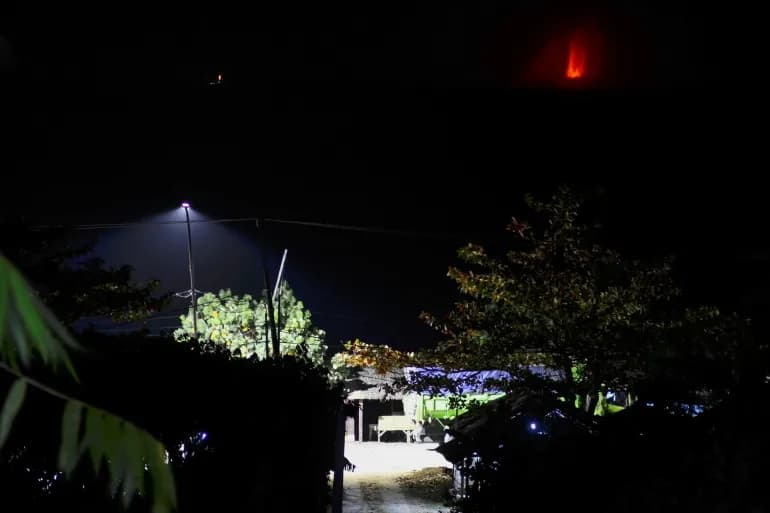
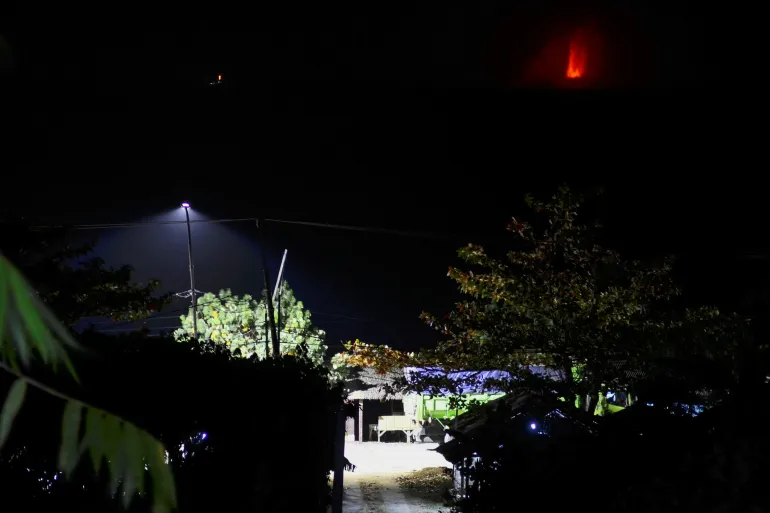 Mount Anak Krakatau volcano spews hot lava as seen from Pasauran village in Serang, Banten province, Indonesia, on September 5, 2026 [Rikardo/Reuters]
Singapore Airlines was among the carriers affected, cancelling two flights to and from Jakarta on Saturday and delaying two more into Sunday.
Indonesia’s disaster mitigation agency said on Saturday that there was no imminent tsunami risk from the eruption.
Anak Krakatau emerged from the sea in the 1920s in the caldera left by the catastrophic 1883 eruption of Krakatoa, one of the deadliest volcanic events in recorded history.
The volcano has erupted periodically in the decades since, including a 2018 eruption that triggered a partial collapse of its crater and a tsunami that killed more than 400 people along the coasts of Java and Sumatra.
Volcanic ash poses a serious hazard to aircraft, capable of damaging jet engines and reducing visibility.












Great article! This really puts things into perspective. I appreciate the thorough research and balanced viewpoint.
Interesting read, though I think there are some points that could have been explored further. Would love to see a follow-up on this topic.
Thanks for sharing this! I had no idea about some of these details. Definitely bookmarking this for future reference.
Well written and informative. The examples provided really help illustrate the main points effectively.
This is exactly what I was looking for! Clear, concise, and very helpful. Keep up the excellent work!