

EU seeks to strengthen trade ties with Australia amid green transition efforts
Brussels aims to secure a limited trade deal with Australia, focusing on green transition resources and imposing strict quotas on Australian meat imports.
Brussels is focusing on securing trade agreements with non-US partners to enhance energy security amid ongoing barriers in EU-US trade negotiations.
European lawmakers are currently working on a limited trade deal with the United States amidst ongoing challenges like 15% tariffs and recent Supreme Court controversies.
Briefing summary
The European Commission announced a focus on securing trade agreements with Australia to bolster economic ties amidst rising energy security concerns due to the Iran war.
Brussels is negotiating to remove trade barriers on critical raw materials from Australia, including lithium and cobalt, aiming to lessen reliance on China.
Conversely, the EU faces challenges in its ongoing trade negotiations with the United States, hampered by existing tariffs and recent legal complications, complicating the path forward.
Watch: What is the EU-Australia trade deal actually about?
Published on
It is an over 20-hour flight to Sydney, but the prize at the end might just be worth it. Or like European Commission President Ursula von der Leyen said, “trade is not just economics, it’s power”.
Let’s take a look.
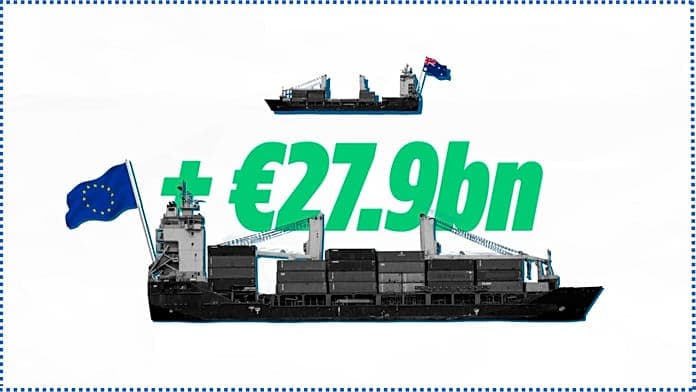
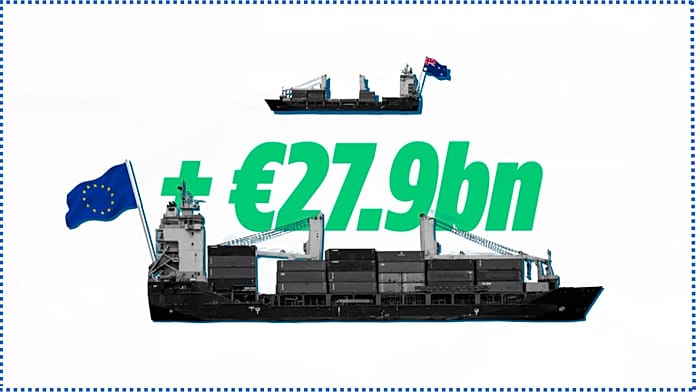
The economic ties are already massive. The EU is currently Australia’s third-largest trading partner, exporting almost €28 billion more in goods than it imports.
For the EU, Australia ranks just 20th. But this deal is not about selling more machinery. It is about securing the green transition — a goal that the Iran war has turned into a matter of sheer energy security.
Australia is the world’s third-largest producer of rare earths, and Brussels wants to remove trade barriers to critical raw materials such as lithium and cobalt without relying on China.
The big sticking point? Agriculture. Fearing a repeat of the Mercosur farmer protests, Brussels is putting a hard ceiling on Australian meat imports, demanding strict quotas and full protection for European food names.
And Brussels is on a roll, sealing recent pacts with Mercosur, India, Mexico, Switzerland, and Indonesia to become the ultimate reliable partner. And as the European Commission president put it, “the world wants to trade with Europe”.
But the EU’s biggest trading partner is noticeably missing: the United States.
For now, European lawmakers are trying to implement a limited trade deal. But between US President Donald Trump’s 15% tariffs and recent US Supreme Court chaos, progress is slow.
Ironically, the biggest obstacle to an EU-US trade deal seems to be the US itself.
Watch the EU News video in the player above for the full story.











Great article! This really puts things into perspective. I appreciate the thorough research and balanced viewpoint.
Interesting read, though I think there are some points that could have been explored further. Would love to see a follow-up on this topic.
Thanks for sharing this! I had no idea about some of these details. Definitely bookmarking this for future reference.
Well written and informative. The examples provided really help illustrate the main points effectively.
This is exactly what I was looking for! Clear, concise, and very helpful. Keep up the excellent work!