

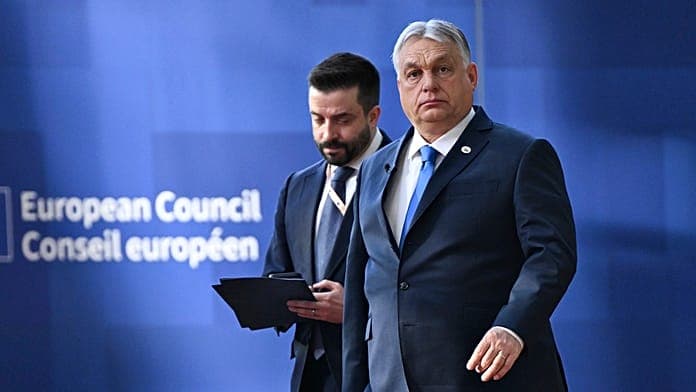
EU leaders express frustration over Hungary’s veto of Ukraine loan deal
Hungary’s Viktor Orbán continues to block a €90 billion loan to Ukraine, creating a significant impasse that jeopardises the country’s financial stability and EU credibility.
German Chancellor Friedrich Merz labelled Viktor Orbán’s actions as “an act of serious disloyalty,” suggesting potential changes to voting rules to prevent future issues.
Ukraine was supposed to receive the first payment of the €90 billion loan in early April, but the Hungarian veto has disrupted this timeline.
Key developments
Following a recent summit, EU leaders condemned Viktor Orbán’s stance, emphasising the need for Hungary to honour commitments made with Ukraine and the EU. Costa highlighted Hungary’s unreasonable conditions amidst ongoing Russian attacks on critical infrastructure.
Brussels announced that Ukraine would permit an external inspection of the pipeline, with EU funding for repairs. However, despite this, Hungary remains unyielding, jeopardising the EU’s institutional credibility and leadership.
The veto by Budapest disrupts the timeline for a crucial €90 billion loan to Ukraine, essential for its government budget through 2026. Slovak Prime Minister Robert Fico warned that he might continue the blockage if Orbán’s conditions are unmet.
‘Nobody can blackmail us’: Leaders excoriate Orbán’s veto as he tests EU limits
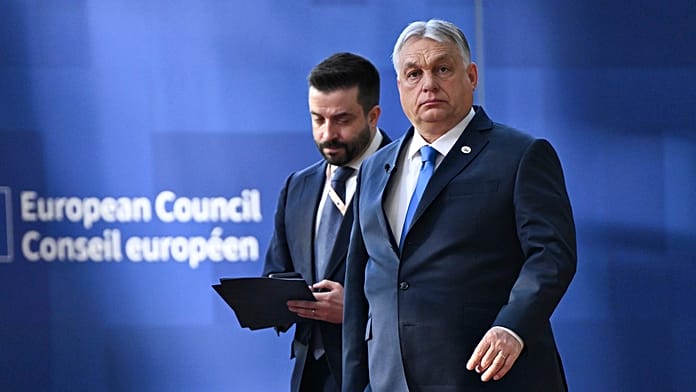
“The leaders took the floor to condemn the attitude from Viktor Orbán, to remember that a deal is a deal and all the leaders need to honour that word,” Costa said at the end of the summit, venting months of frustration over the antics of the Hungarian.
Orbán insists that Ukraine has purposely sabotaged the pipeline to orchestrate an energy crisis ahead of a tight election on April 12. Zelenskyy says the allegation is unfounded but has also lashed out in public at Orbán in multiple occasions.
Costa, according to a diplomat, said both must tone down the rhetoric, but also noted that Hungary is putting on the table impossible conditions, such as ensuring the safety of transit, while Russia keeps pounding Ukraine with missiles and drones.
“This is not acting in good faith, when you put a condition that neither the European Union nor the member states can ensure,” Costa said.
“Because only Russia is willing to decide if they try again to destroy the Druzhba pipeline,” he added, noting Moscow has attacked it more than 20 times since 2022.
“And of course, it is not the responsibility of Ukraine, the Commission, the European Council or any member state.”
In an effort to break the impasse, Brussels announced two days before the summit that Ukraine had allowed an external inspection and the EU would provide funding to fix the pipeline. But the pressure on Zelenskyy to approve the on-site mission failed to get the Hungarian leader to change his mind.
And it now poses a direct threat to the credibility of the institutions, the functioning of the EU and the top leadership from Costa to Commission chief Ursula von der Leyen.
On Thursday evening, von der Leyen said Hungary, alongside Slovakia and the Czech Republic, agreed at the highest political level to go ahead with the loan in December in exchange for being financially exempted. Pushing back so late in the process after approving it presents a serious test from Budapest to Brussels.
“That condition has been fulfilled. So let us be clear about where we stand: the loan remains blocked because one leader is not honouring his word,” she said.
“But let me reiterate what I already said in Kyiv: we will deliver one way or the other.”
Separately, German Chancellor Friedrich Merz accused Orbán of an “act of serious disloyalty” that should be prevented in the future, changing voting rules if necessary.
French President Emmanuel Macron called for the December deal to be respected and warned that concerns about energy security “must not be instrumentalised”.
Sweden’s Ulf Kristersson, Austria’s Christian Stocker and Belgium’s Bart De Wever were among those who criticised Orbán for exploiting the dispute with Kyiv for his re-election campaign, which has taken on a remarkably explosive tone in recent weeks.
High Representative Kaja Kallas went further, questioning the motivations of the veto and the Hungarian arguments: “I guess, in the time of elections, people are not that rational.”
No backing down
After the summit, the Hungarian leader went a step beyond and suggested Brussels is working with Ukraine to force a pro-Brussels government in Budapest.
“The European institutions, including parts of the Commission and the European Parliament, would like to have a change of government in Hungary. And they finance it,” he said as he departed the meeting.
The accusations are not new, but they are serious as they imply political meddling. As the campaign enters its final weeks, Orbán is intensifying his attacks on his opponent, Péter Magyar, as a puppet candidate of von der Leyen and Zelenskyy.
The Hungarian veto comes at a precarious time for Europe.
The United States, under President Donald Trump, has cut off all assistance to Ukraine, leaving Europeans to pick up the tab on their own.
The €90 billion loan agreed in December, following contentious talks among leaders, serves as the backbone of Ukraine’s budget needs for 2026 and 2027. Without it, Ukrainian authorities have warned they may not be able to make ends meet, and that could have serious repercussions on the battlefield.
Under the original plan, Kyiv was supposed to receive the first payment in early April to avoid a sudden cut-off in foreign assistance. But the veto, coupled with the Hungarian vote, has thrown that timeline into disarray.
To make matters more difficult, Slovak Prime Minister Robert Fico, whose country is also connected to Druzhba, has warned that he could continue the blockage if Orbán loses the elections and the pipeline is not repaired.
The dispute poses an exceptionally complex challenge for Brussels, which is caught between safeguarding energy security for member states and supporting Ukraine.

















Great article! This really puts things into perspective. I appreciate the thorough research and balanced viewpoint.
Interesting read, though I think there are some points that could have been explored further. Would love to see a follow-up on this topic.
Thanks for sharing this! I had no idea about some of these details. Definitely bookmarking this for future reference.
Well written and informative. The examples provided really help illustrate the main points effectively.
This is exactly what I was looking for! Clear, concise, and very helpful. Keep up the excellent work!