

EU and US to explore new digital legislation forum after talks
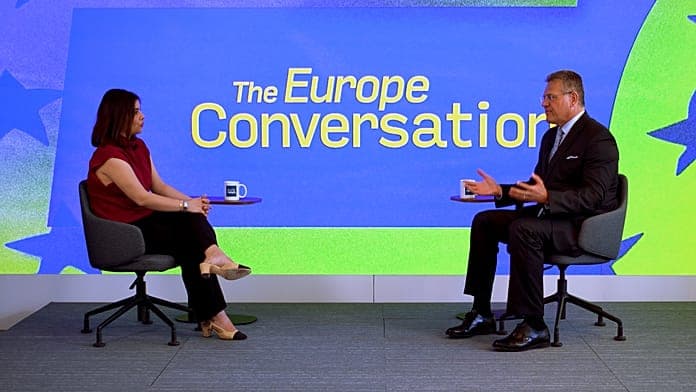
EU Trade Commissioner Maroš Šefčovič announced that the EU and the US are discussing a new forum on digital legislation following pressures from Washington.
The EU and the US are exploring a new forum for digital legislation, reflecting ongoing tensions over EU tech regulations perceived as barriers to US companies.
“We cannot give anything that concerns our legislation, but we are ready to talk,” said Maroš Šefčovič, emphasising the need for a digital dialogue with the US.
Key developments
EU Trade Commissioner Maroš Šefčovič announced discussions with US officials on establishing a new digital legislation forum, responding to ongoing pressure from Washington to modify EU tech regulations.
Šefčovič confirmed that cooperation on digital safety and competition remains essential, citing shared concerns about legislation perceived as discriminatory against US companies operating in Europe.
‘We are ready to discuss digital rules with the US but cannot wipe out rules,’ EU trade chief says

Fresh from Washington after several days of talks with US counterparts, EU Trade Commissioner Maroš Šefčovič told EU News the EU and the US are discussing a new forum on digital legislation, following months of pressure from Washington.
Under the Trump administration, the White House has stepped up calls for Brussels to scale back digital rules it sees as barriers for US Big Tech firms operating in Europe.
So far, the European Commission has refused to reopen its flagship tech laws, which it says are designed to protect consumers and ensure fair competition.
“We cannot give anything that concerns our legislation, but we are ready to talk,” Šefčovič said. “What we both need is a digital dialogue.”
Washington has repeatedly targeted the EU’s Digital Services Act, aimed at tackling illegal content, and the Digital Markets Act, which seeks to curb abuses of market dominance, while reiterating that it sees digital legislation as discriminatory.
Washington set out easing those rules as a condition before reducing US tariffs on steel and aluminium, which have remained at a punitive rate of 50% since June 2025.
While both sides struck a broader trade deal last summer — setting US tariffs on most EU goods at 15% — steel and aluminium were excluded from the deal even as the European industry urges for a resolution to what it calls a prohibitive rate.
Chinese overcapacity as common concern
On digital regulation, Šefčovič said the EU and US share “very common tasks” in several areas, including online safety and fair competition. In recent months, the EU has shifted its strategy by stressing areas of cooperation rather than fines on tech companies.
“What do we want — and what do we not want — appearing on screens for our children? How do we ensure fair competition among operators in the digital market?” he said.
However, he noted that Washington has little interest in reviving the EU-US Trade and Technology Council, which was set up under the Biden administration to treat disputes but has become obsolete under Trump administration.
Šefčovič told EU News the US administration does not seem interested in a “formal structure” and favours direct talks on specific issues.
Still, any perceived flexibility from Brussels on digital issues has yet to translate into progress on steel and aluminium, despite the issue topping last week’s agenda.
“We still have a problem. That’s very clear,” Šefčovič said.
In his visit to Washington, where the two sides agreed to cooperate on critical minerals, the EU’s trade chief said he floated once again the creation of a “steel ring”.
“It’s the best solution for both of us, because we do not have a problem with our mutual steel trade. We have a problem with excessive capacity hitting global markets,” he said.
The commissioner pointed to rising global overcapacity in steel and aluminium
“We are facing 720 million tonnes of excess steel capacity, while European consumption is 140 million tonnes,” he said, stressing the discrepancy the EU faces itself.
China remains the world’s biggest source of overcapacity for both the US and the EU. Chinese overcapacity was a key factor behind President Donald Trump’s decision to impose sweeping tariffs on steel and aluminium imports in the first place.
Šefčovič added that the EU has also responded by cutting imports into the bloc by half through new tariffs and quotas, arguing that both sides face the same concerns.
“We should work together,” he said.














Great article! This really puts things into perspective. I appreciate the thorough research and balanced viewpoint.
Interesting read, though I think there are some points that could have been explored further. Would love to see a follow-up on this topic.
Thanks for sharing this! I had no idea about some of these details. Definitely bookmarking this for future reference.
Well written and informative. The examples provided really help illustrate the main points effectively.
This is exactly what I was looking for! Clear, concise, and very helpful. Keep up the excellent work!