

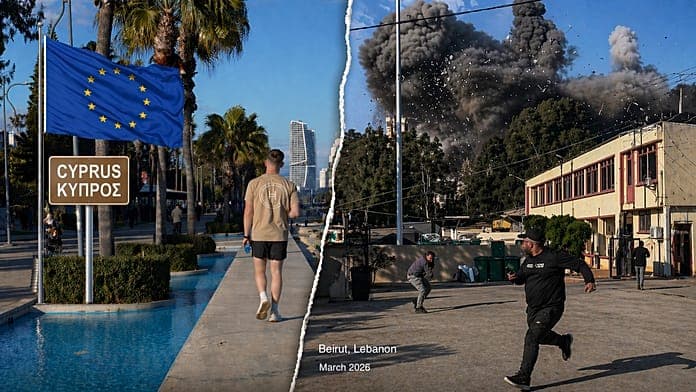
British bases in Cyprus limit response to drone attack, say officials
A drone struck near the British sovereign base areas in Cyprus, leading to the temporary displacement of around 1,000 residents due to insufficient emergency instructions.
The incident revealed a significant legal grey zone, limiting Cypriot authorities’ jurisdiction and emergency response capabilities within the British sovereign base areas.
“For many people, the base is becoming a threat,” stated Pantelis Georgiou, mayor of the Kourion municipality, highlighting the need for clarity on civil protection responsibility.
Key developments
Cyprus has emerged as a strategic frontline amid regional tensions after a drone strike near the British sovereign base areas led to the temporary evacuation of 1,000 residents from Akrotiri.
The incident has raised critical questions about jurisdiction, as Cypriot authorities lack control within the British bases, complicating emergency responses and civil protection responsibilities.
Cyprus: How the Iran war is shaping Europe’s closest frontier to the conflict

Published on •Updated
Cyprus, long seen as a stable country, is now emerging as a strategic frontline — caught between regional tensions, global powers and its own unresolved north-south division.
The British sovereign base areas of Akrotiri and Dhekelia cover around 3% of the Republic of Cyprus, in the south of the island. They go well beyond the perimeter of the bases, overlapping on almost 60% of the municipality of Kourion, home to 40,000 people.
In the village of Akrotiri, located just outside the base, residents are used to the constant presence of jets and patrols and around a third of the population works on the base.
When the drone struck, confusion followed.
“There were sirens, but no clear instructions,” said deputy mayor of Akrotiri Giorgos Kostantinou. The evacuation order came only the next day. Around 1,000 people were temporarily displaced, relying on relatives, hotels and a nearby monastery.
The incident exposed a legal grey zone: Cypriot authorities have no jurisdiction over the British sovereign base areas, limiting their ability to act in emergencies.
Strategic asset or growing threat?
The bases have long been a sensitive issue in Cyprus. Retained by the UK after the island’s independence in 1960, they are seen by some as a colonial legacy.
The right-wing Cypriot government has raised questions about the future of the bases after the drone strike, with the issue remaining a long-standing source of political friction.
“For many people, the base is becoming a threat,” said Pantelis Georgiou, mayor of the Kourion municipality. “We need clarity on who is responsible, especially for civil protection.”
Cyprus, which currently holds the rotating presidency of the Council of the European Union, is not a NATO member and relies on its European allies and the UK for its defence.
Following the attack, several European countries deployed military assets to the region, including Greece, while the UK allowed the US to use its bases for “defensive operations”.
Tourism caught in the crossfire
Despite security concerns, authorities are keen to project calm. Tourism — which accounts for about 12% of Cyprus’s GDP — remains a priority.
Industry representatives have downplayed the incident, but the impact was immediate. Hotel bookings dropped by nearly 40% in March, just as the season was beginning.
Officials insist the long-term impact will depend on how the conflict evolves.
The Middle East crisis is also reverberating through Cyprus’ lasting political divide.
The island has been split since 1974 between the internationally recognised Republic of Cyprus and the self-declared north Cyprus, recognised only by Turkey.
Military posturing on both sides has intensified, with Turkey reinforcing its presence in the north after European deployments in the south.
Analysts warn that the Middle East conflict could deepen divisions and further delay reunification efforts.
For now, daily life continues much as before. But beneath the surface, the war is reshaping the island — politically, economically and socially.
Cyprus remains physically distant from the frontlines, yet increasingly exposed to their consequences. The question is no longer whether the conflict affects the island, but how far those effects will go.









Great article! This really puts things into perspective. I appreciate the thorough research and balanced viewpoint.
Interesting read, though I think there are some points that could have been explored further. Would love to see a follow-up on this topic.
Thanks for sharing this! I had no idea about some of these details. Definitely bookmarking this for future reference.
Well written and informative. The examples provided really help illustrate the main points effectively.
This is exactly what I was looking for! Clear, concise, and very helpful. Keep up the excellent work!