

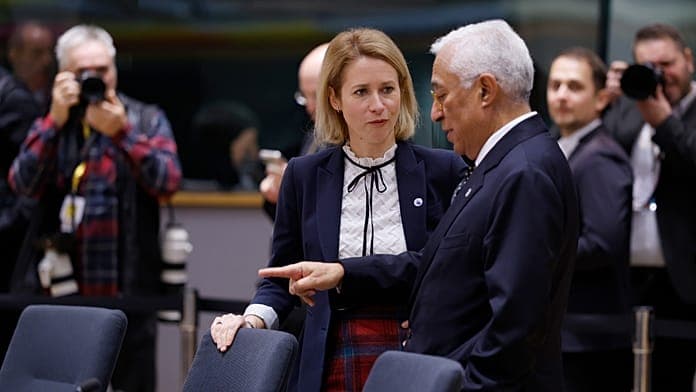
Hungary uses EU veto to block Ukraine aid and sanctions, raising concerns
Hungary has employed its veto power within the EU to block or delay aid to Ukraine and EU sanctions on Russia since 2022.
With 27 EU members, Hungary’s repeated vetoes exemplify a heightened risk of political deadlock, challenging the bloc’s ability to act decisively under geopolitical pressure.
“Vetoes are used as political leverage for unrelated goals,” said Thu Nguyen, acting co-director of the Jacques Delors Centre, highlighting a significant shift in their application.
Key developments
The EU has faced repeated deadlocks in decision-making due to Hungary’s use of its veto power, impacting aid to Ukraine and sanctions on Russia since 2022. This trend reflects a strategic shift in veto usage, according to experts.
Hungary’s recent veto of a previously agreed €90 billion Ukraine loan package marks a significant escalation, as it defied prior commitments not to block such decisions. This development indicates a worrying evolution of political leverage within the EU.
Passerelles, Article 7, coffee breaks: How the EU works around the veto

Under the EU’s unanimity rule, one member state can halt decisions on foreign policy, sanctions, taxation, and enlargement. With 27 members at the table, there is significant potential for deadlock, and in recent years, it has moved from a theoretical risk to a political reality.
Hungary has used the veto, or threatened to, to block or delay Ukraine aid, EU sanctions on Russia, and budget decisions repeatedly since 2022. Experts note a shift in how the veto is used.
“Vetoes are used as political leverage for unrelated goals,” says Thu Nguyen, acting co-director of the Jacques Delors Centre. “Sometimes to unlock EU funds or appeal to domestic voters.”
EU institutions are exhausting every procedural option as the deadlock drags on. Foreign policy chief Kaja Kallas made clear on March 19 that the bloc has mechanisms to break it, but only decisive leadership will deliver results.
The debate is no longer just about Hungary. It is about whether the EU’s decision-making architecture is fit for purpose amid geopolitical pressure.
A new form of escalation
Nguyen points to the €90 billion Ukraine loan package, agreed in December 2025 with an opt-out for Hungary, Slovakia, and the Czech Republic, as a watershed moment. Hungary subsequently moved to veto the enhanced cooperation arrangement it had already agreed not to block.
“This is, I think, the first time where a member state is vetoing a decision after there had been agreement to, in fact, not veto the decision,” she says. “That veto that comes after having agreed not to veto it is also a new form of use that we have not seen before.”
Dr Patrick Müller, Professor for European Studies at the University of Vienna and the Vienna School for International Studies, describes the broader dynamic as deliberate and strategic. “One could just call it blackmail or hard bargaining,” he says. “But the way Hungary goes about it is that it tries to veil this link, so it’s not easy to detect because it’s not explicit.”
There are four main tools the EU can use to work around a veto. None of them is clean. All of them carry trade-offs.
Passerelle clauses: the switch nobody flips
Activating these clauses demands the same consensus they aim to replace. Since their 2009 introduction, none has been used. As Nguyen says, “The big problem is you can only end unanimity with unanimity.”
Constructive abstention: Opting out without shutting down
Under EU foreign policy rules, a member state can abstain from voting rather than block it, pledging not to interfere with the decision while distancing itself politically. It has been used twice. In 2008, Cyprus abstained on the launch of EULEX Kosovo.
In 2022, Ireland, Austria, and Malta abstained from allowing lethal aid to Ukraine through the European Peace Facility, unwilling to co-fund weapons deliveries but unwilling to stop others from doing so.
Constructive abstention is a niche tool. It only works if a state steps aside rather than fights.
Coalitions of the willing: Moving without the full bloc
But Nguyen warns that the limits of this approach are already visible. “We have seen European Council conclusions now split in two, a general one with all 27 member states, and one that relates to Ukraine with only 26,” she says. “That creates the impression that the EU is not able to act as one unity and not able to act decisively and efficiently.”
Article 122: The emergency clause under strain
The Article 7
One rarely discussed mechanism: Article 7 of the TEU allows the EU to suspend a member’s voting rights if it breaches EU values. It was triggered against Hungary in 2018 but has stalled.
“There is a procedure that allows the EU to suspend the voting rights of a member state that fundamentally breaches the values of the European Union,” Nguyen notes. “If there is any solution, it would probably be this one.” But she acknowledges the practical obstacles: “There has always been a lot of reluctance in the Council to implement this very drastic measure, and there has also always been more than one member state that perhaps runs the risk of having its rights suspended under Article 7.”
The EU is not changing its rules. It is bending them more frequently and more creatively than ever before.
Müller argues the bigger risk is what repeated workarounds signal to other governments. “If we go for easy fixes, if we go for compromises and give a government the feeling that this hostage taking is a way to blackmail us, you create incentives to do it in the future as well,” he says.


Great article! This really puts things into perspective. I appreciate the thorough research and balanced viewpoint.
Interesting read, though I think there are some points that could have been explored further. Would love to see a follow-up on this topic.
Thanks for sharing this! I had no idea about some of these details. Definitely bookmarking this for future reference.
Well written and informative. The examples provided really help illustrate the main points effectively.
This is exactly what I was looking for! Clear, concise, and very helpful. Keep up the excellent work!