

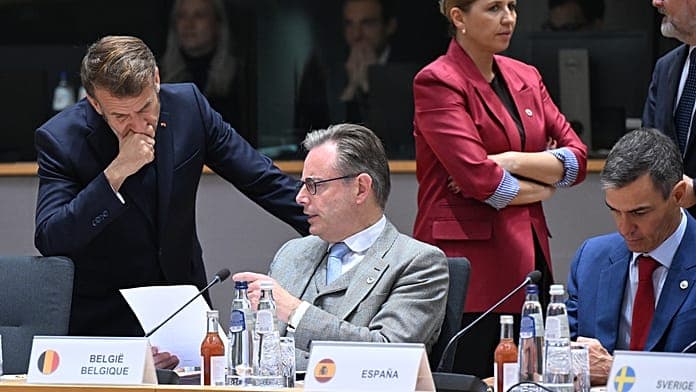
EU leaders focus on Ukraine and Middle East crisis ahead of summit
Hungarian Prime Minister Viktor Orbán blocked a €90 billion EU loan for Ukraine, citing pipeline disruptions from Ukraine, straining relations with Kyiv ahead of an upcoming election.
Ten EU nations urge overhaul of carbon pricing rules, citing existential risk to industries due to soaring energy prices amid the Middle East crisis.
Leaders will convene for discussions on the Middle East and Ukraine, with a vote on carbon pricing to be revisited before the summit concludes tomorrow.
Briefing summary
Diplomats confirmed that discussions on the Middle East will centre on the war’s economic impact, while EU governments resisted US calls to deploy frigates to the Strait of Hormuz.
Leaders are focused on Ukraine, with Hungarian Prime Minister Viktor Orbán’s veto of a €90 billion loan causing outrage. Orbán cites the closure of the Druzhba pipeline as a key issue.
A major rift has emerged over the EU’s carbon pricing rules, as ten countries call for an overhaul. In contrast, eight nations, including the Netherlands and Spain, support maintaining current policies.
Newsletter: Iran war and Druzhba dispute to dominate EU leaders’ summit
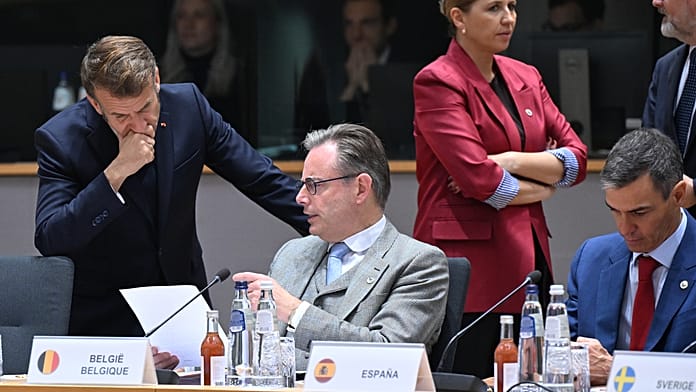
Diplomats say the discussions on the Middle East will focus on the economic fallout of the war, as Europeans continue to distance themselves from the conflict itself despite US President Donald Trump’s calls for allies’ assistance.
EU governments have in fact resisted US pressure to deploy frigates to the Strait of Hormuz to help restore the flow of oil and gas supplies. But leaders could mull strictly diplomatic solutions to restore freedom of navigation in the critical maritime artery when they meet later, with UN Secretary General António Guterres joining the debate in the afternoon.
Leaders are also intent on keeping the political focus on Ukraine as the Middle East crisis risks diverting attention.
From the moment leaders arrive, all eyes will be on Hungarian Prime Minister Viktor Orbán, whose decision to block a €90 billion EU loan for Ukraine at the very last stage of the legislative process has caused widespread outrage and anger, my colleague Jorge Liboreiro writes in this must-read preview.
Orbán gave his political blessing to the loan back in December after negotiating an opt-out from financial contributions along with Slovakia and the Czech Republic. But he has since vetoed the loan amid the interruption of oil deliveries to Hungary through the Druzhba pipeline, claiming Ukrainian President Volodymyr Zelenskyy has closed off the pipeline for “political reasons”.
Kyiv says part of the pipeline in Ukraine was damaged in a Russian drone strike in late January. But Zelenskyy has also clearly expressed his wish for the pipeline to remain shut to avoid feeding President Putin’s warchest – further inflaming Orbán and pitting both leaders against each other in a war of words. Zelenskyy is expected to dial in to the summit to brief leaders on the situation in Ukraine tomorrow.
The dispute over Druzhba has become a focal point in Orbán’s re-election campaign, as he aims to portray Kyiv and Brussels as colluding to support opposition leader Péter Magyar, who has been consistently leading in the polls. This hasn’t gone unnoticed in other capitals, Jorge writes, fuelling further exasperation.
Although Zelenskyy has accepted the European Commission‘s demand for an external inspection of the damaged section of the pipeline, hopes for a resolution before the Hungarian election on 12 April are slim – Orbán insists he won’t drop his veto until Russian crude is flowing through Druzhba to Hungary again.
Soaring energy prices as a result of the Iran war’s squeeze on global supplies will also be on leaders’ agenda. Context: Overnight, Trump vowed to “blow up the entirety” of Iran’s South Pars gas, after Iran pounded Qatar’s Ras Laffan energy complex in response to an Israeli attack on its gas field.
A major rift has emerged ahead of the summit on the EU’s carbon pricing rules, known as the Emissions Trading System (ETS), with a group of 10 countries including the Czech Republic, Italy, Hungary and Romania calling for an overhaul of the current rules, which they say represent an “existential risk” for European industry.
The ETS is essentially a climate policy tool capping how much industries can pollute and allowing companies to buy and sell emissions allowances. The 10 countries say the system is moving too fast on the phase-out of free allowances, as strategic EU sectors come under extra pressure amid soaring energy prices.
Eight countries – including the Netherlands, Spain and Sweden – have emerged as proponents of the ETS. They argue that the crisis in the Middle East, which has prompted the de facto closure of the Strait of Hormuz and a major crunch on global energy supplies, has served as proof that the bloc’s continuing reliance on fossil fuels makes it vulnerable. Commission chief Ursula von der Leyen has also brushed off calls to overhaul the rules. Marta Pacheco has more on the dividing issue.
Don’t miss our special live broadcast from the EU leader’s summit tonight at 19.00 Brussels time on EU News. The expectation is that the summit could continue into Friday – we’ll bring you all the developments in tomorrow’s newsletter.
‘A major mistake’, EPP anniversary spoiled by cooperation with far-right in EU Parliament
Glasses of champagne were raised at the European People’s Party’s 50th anniversary on Wednesday at a fancy venue in Brussels – but the spectre of the far-right lingered over the event, as the EPP mulls over its most fundamental dilemma in decades: what is the future of the European conservatives?
The leadership of Europe’s oldest and most powerful political force is grappling with allegations that it coordinated its work in the European Parliament with anti-EU forces – including Germany’s far-right AfD – via a WhatsApp group.
The episode is significant as it shows an institutionalised cooperation and it suggests the firewall that bans cooperation with parties until recently deemed too toxic to work with in national capitals is breaking in Brussels.
“It was a major mistake”, a heavyweight member of the party, granted anonymity to speak freely, told EU News’ Vincenzo Genovese. The WhatsApp chat story was discussed on the sidelines of the event, Vincenzo reports, with several members of the party worried about its implications and the message it sends.
“This is a very delicate issue for us: in my country, our voters do not tolerate it” said a former German MEP.
Read Vincenzo’s full story.
Iceland sees EU membership as safe bet after Trump’s Greenland threats
Iceland’s Foreign minister Thorgerdur Katrín Gunnarsdóttir has told Europe Today that EU membership for her island nation could strengthen economic security and provide cover among like-minded states, despite it already being a member of NATO.
Reykjavík watched with trepidation when Trump said he would “take” Greenland, a semi-autonomous Arctic island within the NATO alliance, last January before threatening additional 10% tariffs on eight European states when they announced they would join a reconnaissance mission to Greenland amid the threats.
While the arguments in favour of joining the EU are clear to her – greater security within a group of 28 amid an unstable global outlook – Thorgerdur Katrín says the Brexit debate in the UK is a cautionary tale; not to take anything for granted.
“Everyone knows about Brexit and all the lies that were put on the table in that process”, she said. “It will not be an easy walk, but in the end, you know, you have to trust the nation.”
Catch the full interview on this morning’s editionof Europe Today.
More from our newsrooms
‘48 hours and €100’: EU presents sped-up business registration law. The European Commission has unveiled new rules known as ‘the 28th Regime’ or ‘EU Inc.’ to make Europe more attractive for business and better able to compete globally with powers like China and the US. Eleonora Vasques has more.
Von der Leyen to visit Australia as trade deal nears finish line. The European Commission is eyeing another deal in its push to diversify trade ties, with President Ursula von der Leyen set to visit Australia from March 23 to 25 to clinch a long-awaited agreement. Peggy Corlin has more.
We’re also keeping an eye on
- EU leaders gather for pre-summit breakfasts with their European political families. The centre-right European People’s Party, centre-left Socialists and Democrats and centrist Renew Europe are gathering in separate hotels across Brussels.
- EU enlargement chief Marta Kos is in Armenia.
That’s it for today. Remember to sign up to receive Europe Today in your inbox every weekday morning at 08.30.







Great article! This really puts things into perspective. I appreciate the thorough research and balanced viewpoint.
Interesting read, though I think there are some points that could have been explored further. Would love to see a follow-up on this topic.
Thanks for sharing this! I had no idea about some of these details. Definitely bookmarking this for future reference.
Well written and informative. The examples provided really help illustrate the main points effectively.
This is exactly what I was looking for! Clear, concise, and very helpful. Keep up the excellent work!