

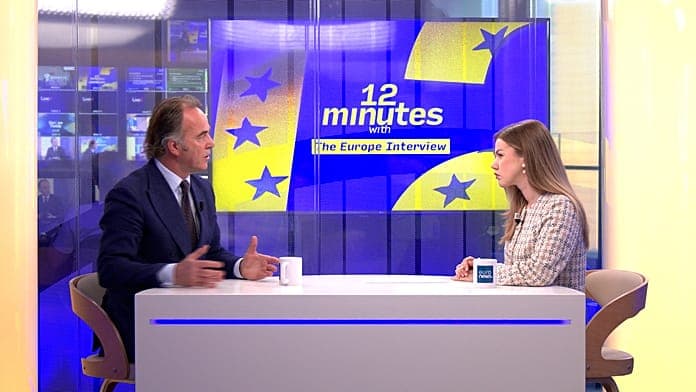
EU counter-terrorism coordinator warns of rising radicalisation among youth
Europol reported a significant increase in minors involved in terrorism-related activities in the EU, with 133 arrests of individuals aged 12 to 20 in 2024.
Europol’s 2025 terrorism report highlights a troubling rise in minors involved in terrorism, with 133 arrests of individuals aged 12 to 20 in 2024.
Europol’s 2025 report indicates a significant rise in minors involved in terrorism, with 133 arrests in 2024 alone.
Briefing summary
EU Counter-Terrorism Coordinator Bartjan Wegter confirmed a rise in radicalisation among young people, with some as young as 12 being involved in terrorism-related activities. In 2024, 133 of the 449 arrests were minors.
Wegter noted a concerning trend of youth being drawn into online communities promoting violent extremism, often labelled as “salad bar ideology.” This phenomenon complicates traditional definitions of terrorism.
Children as young as 12 are getting radicalised in Europe, EU counter-terrorism chief tells EU News

Radicalisation in Europe has been on the rise, especially among young people, EU Counter-Terrorism Coordinator Bartjan Wegter told EU News, with Europe’s security services now dealing with cases involving children as young as 12.
“We’re talking about minors (and youth) aged between 12 and 20 years old,” Wegter told EU News’ 12 Minutes With, adding that a huge challenge for law enforcement is that young people radicalise very quickly. “Sometimes, it’s a matter of weeks.”
Wegter explained that at that age, minors are generally very susceptible and are therefore targeted online for criminal activity, even if in real life they do not have any criminal record.
According to recent studies, young people spend between five and eight hours per day on social media, with radicalisation and recruitment taking place online in these spaces and without any in-person meetings.
“So, it’s very difficult for our law enforcement to capture this,” the EU counter-terrorism coordinator said.
“It’s a matter of exchanging good practices. Sharing data, sharing information, but also very much monitoring the online environment, which is where much of this takes place.”
Wegter reiterated that more time spent online is not necessarily negative in itself, but “it’s a matter of educating youth” and cooperating with the websites and platforms where young Europeans spend most of their time.
“It is also a matter for dialoguing with the platforms and the industry to ensure that they take their responsibility in countering the kind of content that is leading to the radicalisation of our young people.”
Growing threat of online communities inciting violence
Europol’s — the EU law enforcement organisation — latest terrorism trend assessment indicates a clear rise in the involvement of minors and young adults in terrorism‑related behaviour across the European Union.
According to the 2025 European Union Terrorism Situation and Trend Report, 449 people were arrested for terrorism‑related offences in the EU in 2024.
Almost a third of them — 133 people — were aged between 12 and 20 years. The youngest offender was 12 and arrested for planning to commit an attack.
Wegter insisted that “jihadism remains the number one threat in Europe”.
“That’s the number-one threat to our security,” Wegter told EU News, adding that its tactics have changed over the past decade.
He added that although the so-called Islamic State (IS) no longer exists as a physical entity, the extremist group “has adapted its tactics and it has been very agile”.
The IS or Daesh rose to prominence in the mid-2010s but has been largely decapitated following the loss of the territories it occupied in the Middle East except for some pockets in the Syrian desert, and now operates in a decentralised way through its affiliates and global terror operations.
Wegter explained that its command centres have been decentralised, meaning that “it has now different frontlines in the global war of jihad in different regions”.
“Also, instead of organising the sort of large-scale concerted attacks from outside the EU’s borders, it has now shifted tactics to really trying to recruit people, very often young adolescents, from within the EU.”
The rise of ‘nihilistic violent extremism’
On top of jihadist radicalisation challenges, Europe faces an alarming shift in extremism: violent right-wing and left-wing ideologies are surging online, luring young people into “communities”.
Wegter says these communities or networks then operate on the basis of “salad bar ideology”.
**“**There are very often different parts of different ideologies that are put together in a sort of mishmash of very negative, very violent, let’s say, motivations.”
And the rise of the “salad bar extremism” then develops into a new trend, which Wegter describes as “nihilistic extremist violence”.
These hardcore ideologies typically combine racism, misogyny, and other extreme ideas and target young people who “don’t have any ideological baggage are very much drawn to extreme violence.”
This brand new phenomenon doesn’t “neatly fit into the box of strictly speaking terrorism”, Wegter said.








Great article! This really puts things into perspective. I appreciate the thorough research and balanced viewpoint.
Interesting read, though I think there are some points that could have been explored further. Would love to see a follow-up on this topic.
Thanks for sharing this! I had no idea about some of these details. Definitely bookmarking this for future reference.
Well written and informative. The examples provided really help illustrate the main points effectively.
This is exactly what I was looking for! Clear, concise, and very helpful. Keep up the excellent work!