


Media Lens: Ukrainian drone strikes kill nine and injure over sixty across Russia
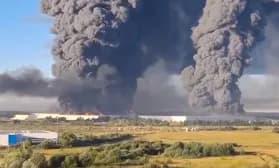
Ukrainian drone attacks killed seven warehouse workers in Russia and sparked a fire at an oil depot in the Moscow region. The incident occurred during a series of coordinated strikes across various locations in Russia.
Quick links: What has happened | Status quo | Confirmed facts | Preconceptions | Elisions | One story, four angles | Related links
What has happened
Ukrainian drone attacks targeted various locations in Russia, including online retail warehouses, resulting in the deaths of at least nine individuals. This series of strikes, described as some of the deadliest in the past two years, prompted significant fires and destruction in affected areas.
The attacks specifically struck facilities in the Moscow region, leading to widespread damage and injuries among workers. Reports indicate that among those killed, warehouse personnel were prominent, highlighting the severe impact of these military operations on civilian infrastructure.
Status quo
Ukrainian drone attacks have recently targeted various locations within Russia, resulting in significant casualties and damage. Reports indicate that approximately seven warehouse workers were killed in strikes that also ignited a fire at an oil depot in the Moscow region. These incidents mark a continuation of escalating military actions between Ukraine and Russia amid ongoing tensions.
Confirmed facts
- Ukrainian drone attacks killed seven warehouse workers in Russia.
- The drone strikes caused a fire at an oil depot in the Moscow region.
- Two separate attacks occurred, with warehouse workers affected in both instances.
- Reports confirm at least nine individuals were killed overall in these attacks.
- More than sixty people sustained injuries due to the drone strikes.
Preconceptions
- Prioritisation of Casualties: Reuters focuses on the deaths of warehouse workers in the context of Ukrainian drone strikes, highlighting the human impact first. In contrast, BBC emphasizes the broader impact of Ukrainian strikes on Russian retail logistics without specifying casualties immediately.
- Emphasis on Damage: CNN stresses the ‘deadliest’ aspect of the attacks over the scale of destruction, while The Hill prioritizes the number of injured, emphasizing casualties rather than property loss.
- Reduction of Context: The Hill provides more background on the political implications of the drone attacks, whereas Reuters limits the context to immediate effects, reducing the analysis of potential future consequences.
Elisions
- BBC reports on Ukrainian drone attacks causing fatalities among warehouse workers, highlighting the scale of casualties as significantly high (9 killed, over 60 wounded) compared to Reuters, which notes only 7 fatalities without specifying injury numbers.
- The Hill emphasizes the targets of drone strikes on Russian retail warehouses, while CNN focuses on the broader implications of the attacks, labeling it the deadliest in two years, demonstrating a narrative variation in the significance of these events.
- Both Reuters and The Hill mention casualties from drone strikes, but The Hill highlights a larger scope of impact (wounding over 60 people) which is omitted from the Reuters report, suggesting a gap in casualty reporting.
One story, four angles
Reuters – Ukrainian drone attacks kill seven warehouse workers in Russia, spark fire at Moscow region oil depot
Publication: Reuters | Intensity: (5/10) | Sentiment: Neutral | Legal precision: Medium
Expand
Espresso Shot: The article emphasizes the drone attacks’ impact on civilian lives, noting that seven warehouse workers were killed. The initial focus is on casualties, highlighted first in the headline.
Key differences:
– **Comparison with BBC:** Unlike BBC, which highlights the scope of the attacks, Reuters begins with human casualties to evoke emotional response, e.g., “killing seven warehouse workers.”
– **Use of Active Voice:** Reuters employs direct terms like “spark fire,” creating urgency, contrasting with CNN’s more passive language about the incident.
– **Factual Reporting vs. Context:** Reuters sticks to casualties without extensive political context, while CNN broadens the narrative scope, e.g., incorporating background on the ongoing conflict.
Bias: Selection: Focus on immediate casualties | Language: Direct and urgent phrasing | Omission: Greater context on the wider conflict and political implications.
Assessment: The reader believes that the severity lies in the immediate fatalities of the drone attacks.
BBC – Russian online retail warehouses hit by deadly Ukrainian strikes
Publication: BBC | Intensity: (4/10) | Sentiment: Neutral | Legal precision: Medium
Expand
Espresso Shot: BBC draws attention to the broader impact of the strikes on Russian commerce, which sets a different narrative focus compared to Reuters’ casualty-centric approach.
Key differences:
– **Scope of Impact:** BBC contextualizes its article by discussing the economic repercussions, a method not seen in Reuters, e.g., mentioning “online retail warehouses.”
– **Language Use**: Unlike Reuters’ factual framing, the BBC portrays the strikes using “deadly,” which indicates severity while leaving interpretation open.
– **Attribution Style:** BBC mentions “Russian side” to frame the narrative from a geopolitical standpoint, contrasting with Reuters’ focus on direct effects.
Bias: Selection: Emphasis on economic loss | Language: Subtle implications of severity | Omission: Less emphasis on casualties compared to Reuters.
Assessment: Readers perceive a broader context that includes economic impacts, potentially downplaying immediate human tragedies.
The Hill – Ukrainian drones hit warehouses and other sites across Russia, killing 9 and wounding over 60
Publication: The Hill | Intensity: (6/10) | Sentiment: Mixed | Legal precision: Medium
Expand
Espresso Shot: The Hill emphasizes both casualties and geographical impact, showcasing the expansive scope of the drone attacks while highlighting the casualties to evoke empathy.
Key differences:
– **Comparative Casualties:** The Hill reports higher casualty numbers (9 killed, over 60 wounded) compared to Reuters, shifting the focus, “Ukrainian drones hit warehouses,” to heighten urgency.
– **Geographical Scope:** Unlike Reuters, The Hill elaborates on the extent of the strikes within Russia, citing “other sites,” broadening its geographical narrative.
– **Casualty Language:** The phrase “killing 9 and wounding over 60” indicates severity more strongly than both BBC and Reuters, framing the event as a critical escalation.
Bias: Selection: Highlights severe impacts | Language: Emotional and urgent | Omission: Less focus on the implications of these actions within broader geopolitical contexts.
Assessment: Readers are led to believe this is a significant escalation and that the humanitarian toll is severe.
CNN – Warehouse workers among 8 dead in deadliest Ukrainian attacks inside Russia for two years
Publication: CNN | Intensity: (7/10) | Sentiment: Negative | Legal precision: Medium
Expand
Espresso Shot: CNN takes an emotional angle, leading with the death toll and declaring these attacks as among the deadliest, immediately setting a somber tone for readers.
Key differences:
– **Tone and Language:** CNN uses “deadliest” to highlight the severity of the attacks, differentiating it from Reuters’ and BBC’s neutral tones.
– **Casualty Details:** The wording “Warehouse workers among 8 dead” humanizes casualties by specifying the victims’ roles, unlike the more detached reporting in other outlets.
– **Historical Context:** CNN frames the event within the context of a two-year timeline, enhancing the perception of escalation compared to BBC and Reuters, which lack this historical lens.
Bias: Selection: Focus on human tragedy and loss of life | Language: Evocative and somber | Omission: Less emphasis on geopolitical implications and wider context.
Assessment: Readers are led to believe this incident marks a significant and tragic escalation in the ongoing conflict.
In comparing recent coverage of Ukrainian drone strikes, Reuters employs a starkly factual tone, reporting seven fatalities among warehouse workers while focusing on the incident’s immediate impact. In contrast, BBC’s framing escalates the narrative by highlighting “deadly Ukrainian strikes,” imbuing the events with a sense of urgency and threat. The Hill intensifies the escalation, emphasizing casualties and extensive damage, while CNN labels these strikes “the deadliest… for two years,” invoking historical context. Ultimately, Reuters offers the most straightforward framing, whereas CNN and The Hill heighten its implications. The facts do not change. What changes is where scrutiny lands.
Related links
Reuters
BBC
Russian online retail warehouses hit by deadly Ukrainian strikes
The Hill
Ukrainian drones hit warehouses and other sites across Russia, killing 9 and wounding over 60
CNN
Warehouse workers among 8 dead in deadliest Ukrainian attacks inside Russia for two years













Great article! This really puts things into perspective. I appreciate the thorough research and balanced viewpoint.
Interesting read, though I think there are some points that could have been explored further. Would love to see a follow-up on this topic.
Thanks for sharing this! I had no idea about some of these details. Definitely bookmarking this for future reference.
Well written and informative. The examples provided really help illustrate the main points effectively.
This is exactly what I was looking for! Clear, concise, and very helpful. Keep up the excellent work!