


Media Lens: Trump, Xi Jinping and Putin convene at trilateral summit
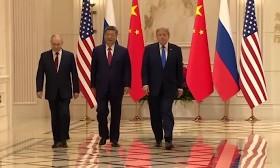
Donald Trump, Xi Jinping, and Vladimir Putin recently held a trilateral summit discussing key global issues. The summit took place in an undisclosed location.
Quick links: What has happened | Status quo | Confirmed facts | Preconceptions | Elisions | One story, four angles | Related links
What has happened
Donald Trump, Xi Jinping, and Vladimir Putin convened for a trilateral summit to discuss various global issues and diplomatic strategies. The meeting took place in Beijing, China, serving as a platform for the leaders to strengthen their collaborative efforts in addressing international challenges.
During the summit, the leaders focused on topics such as economic cooperation, security matters, and regional stability. This meeting marked a significant occasion for China, Russia, and the United States as they navigated complex geopolitical dynamics in the current global landscape.
Status quo
N/A
Confirmed facts
- Donald Trump, Xi Jinping, and Vladimir Putin held a trilateral summit.
- The summit was perceived as possibly benefitting Xi Jinping and Vladimir Putin.
- There was speculation about the implications of this summit on international relations, particularly concerning middle powers.
- The summit occurred amid ongoing geopolitical tensions, including the war in Ukraine.
- Multiple news sources reported on the summit, highlighting its significance.
Preconceptions
- Reuters emphasizes the geopolitical implications of the trilateral summit, highlighting Trump’s role in fostering collaboration among Xi and Putin, while underplaying domestic concerns.
- CNN prioritizes a narrative framing the summit as a validation of Xi and Putin’s positions in the global landscape, emphasizing their perceived gains over America’s international standing.
- CNBC focuses on the implications of the summit for Putin amidst the ongoing Ukraine conflict, presenting it as a significant personal victory, while reducing attention on broader diplomatic contexts.
- The Times critiques Trump’s performance, framing it as a domestic failure despite his international engagements, placing more emphasis on Trump’s internal challenges than on foreign policy successes.
Elisions
- The coverage of the trilateral summit varies in emphasis among sources; *CNN* highlights Xi and Putin’s strategic positioning in relation to global order, while *Reuters* focuses on the implications for U.S. foreign policy and its allies, resulting in different narratives regarding the balance of power.
One story, four angles
Reuters – As Trump courts Xi and Putin, middle powers make their own moves
Publication: Reuters | Intensity: (7/10) | Sentiment: Neutral | Legal precision: Low
Expand
Espresso Shot: The report focuses on the geopolitical shifts and emerging middle powers in response to a trilateral meeting involving Trump, Xi, and Putin.
Key differences:
1. Comparison of tone: Reuters employs a neutral tone, emphasizing middle power actions rather than predominant actors like Trump, e.g., “middle powers make their own moves.”
2. Placement of key elements: The article opens with multilateral scenarios rather than the meeting’s outcomes, guiding reader focus away from individuals’ power struggles.
3. Use of language: The term “middle powers” is highlighted, suggesting a strategic emergence while keeping a distance from direct critiques of the leaders.
Bias: Selection: Focus on the concept of middle powers, potentially downplaying direct consequences for the major leaders involved. | Language: Uses neutral language, which could mask underlying tensions. | Omission: Lacks substantial discussion on the direct outcomes of the summit for involved leaders.
Assessment: Readers are led to believe that the trilateral summits are creating opportunities for less influential nations, overshadowing the primary leaders.
CNN – For Xi and Putin, the Trump trilateral was a win for a new world order
Publication: CNN | Intensity: (8/10) | Sentiment: Negative | Legal precision: Moderate
Expand
Espresso Shot: The article draws attention to the strategic gains for Xi and Putin, framing the meeting as affirming their positions in a shifting global landscape.
Key differences:
1. Tone approach: CNN’s choice of “win for a new world order” carries a more subjective interpretation of the outcomes compared to Reuters’ neutrality.
2. Focus on individual leaders: This article forefronts Xi and Putin’s perspectives and gains, e.g., “for Xi and Putin,” which shapes a narrative of empowerment versus a collective outcome.
3. Implication of intent: Terms like “new world order” suggest a more critical stance on geopolitical shifts compared to Reuters’ neutral commentary on middle powers.
Bias: Selection: Focuses on the perspectives of Xi and Putin and downplays any negative implications for Trump. | Language: Uses charged phrases such as “new world order,” suggesting an alarmist tone. | Omission: Doesn’t explore the criticisms or dissenting opinions about the leaders involved.
Assessment: Readers quickly gather that the trilateral meeting primarily serves the interests of Xi and Putin, positioning Trump as less influential.
CNBC – Putin scores ‘massive win’ at first trilateral meeting, rebuilding standing as Ukraine war grinds on
Publication: CNBC | Intensity: (9/10) | Sentiment: Negative | Legal precision: Low
Expand
Espresso Shot: CNBC accentuates Putin’s perceived victories and improved stature amid ongoing global tensions, lending a critical eye toward the implications for Ukraine.
Key differences:
1. Dominant framing: CNBC uses assertive language like “massive win,” amplifying Putin’s gains compared to CNN’s subtler language about a “new world order.”
2. Perspective emphasis: Directly attributes outcomes to Putin’s agency, e.g., “rebuiling standing” as opposed to collaborative achievements noted in Reuters.
3. Overarching consequences: The report highlights geopolitical ramifications focusing on Ukraine, emphasizing instability.
Bias: Selection: Prioritizes Putin’s narrative over collective outcomes, likely drawing criticism towards western powers. | Language: The word choice implies significant admiration for Putin’s actions, changing the narrative tone. | Omission: Details surrounding dissent or resistance within Ukraine are not elaborated upon.
Assessment: Readers are led to believe that this trilateral summit significantly bolsters Putin’s position and potentially exacerbates the Ukraine situation.
The Times – Trump’s world stage ‘triumph’ is turning into a domestic disaster
Publication: The Times | Intensity: (8/10) | Sentiment: Negative | Legal precision: Low
Expand
Espresso Shot: The article frames Trump’s international actions negatively, suggesting that successes abroad are overshadowed by domestic challenges.
Key differences:
1. Critique focus: The use of “domestic disaster” starkly contrasts with the framing that highlights geopolitical wins, positioning Trump’s actions as counterproductive.
2. Prioritization of implications: The article quickly foregrounds domestic repercussions rather than international achievements, a deviation from how other outlets approach the topic.
3. Language nuances: Phrases like “triumph” juxtaposed with “disaster” create a dramatic tension highlighting discord which other articles lack.
Bias: Selection: Highlights the detrimental impacts of Trump’s actions on domestic politics, minimizing international successes. | Language: Firmly critical, which shapes reader sentiment against Trump’s administration. | Omission: Less attention to the outcomes for other leaders or global contexts surrounding the meeting.
Assessment: The reader likely perceives that Trump’s international endeavors are undercut by significant problems at home.
In this analysis of the trilateral summit, CNN frames it as a “win for a new world order” for Xi and Putin, emphasizing gains in global positioning, while CNBC characterizes the meeting as a “massive win” for Putin, highlighting the context of the Ukraine conflict. Conversely, The Times presents the summit as a potential “domestic disaster” for Trump, framing it more critically instead of focusing on international advancements. Thus, while CNN and CNBC engage in more affirmative portrayals, The Times offers a more escalatory critique. The facts do not change. What changes is where scrutiny lands.
Related links
Reuters
As Trump courts Xi and Putin, middle powers make their own moves
CNN
For Xi and Putin, the Trump trilateral was a win for a new world order
CNBC
Putin scores ‘massive win’ at first trilateral meeting, rebuilding standing as Ukraine war grinds on
The Times
Trump’s world stage ‘triumph’ is turning into a domestic disaster








Great article! This really puts things into perspective. I appreciate the thorough research and balanced viewpoint.
Interesting read, though I think there are some points that could have been explored further. Would love to see a follow-up on this topic.
Thanks for sharing this! I had no idea about some of these details. Definitely bookmarking this for future reference.
Well written and informative. The examples provided really help illustrate the main points effectively.
This is exactly what I was looking for! Clear, concise, and very helpful. Keep up the excellent work!