


Media Lens: Train derails in France injuring 44 as authorities investigate sabotage
A train derailed between Rouen and Caen in France, resulting in at least 44 injuries. French officials investigate whether a malicious act caused the accident.
Quick links: What has happened | Status quo | Confirmed facts | Preconceptions | Elisions | One story, four angles | Related links
What has happened
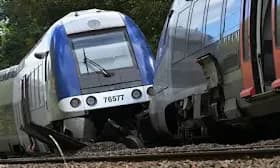
A passenger train derailed near the towns of Rouen and Caen in France on September 12, 2026, injuring at least 44 people. Among the injured, one teenager was airlifted to a hospital, and authorities are investigating the incident as a potential malicious act.
French officials are currently examining whether sabotage contributed to the derailment, which occurred during a routine journey. Emergency services were promptly dispatched to the scene to assist the injured and secure the area as the investigation unfolds.
Status quo
A passenger train derailed between Rouen and Caen in France on September 12, 2026. The incident resulted in at least 44 injuries, with one individual reported in critical condition. French authorities are investigating the derailment, considering the possibility of sabotage as a contributing factor. Emergency services responded promptly, providing medical attention to the injured passengers and ensuring safety along the affected railway line.
Confirmed facts
- A train derailed between Rouen and Caen in France.
- At least 44 people were injured in the incident, including one person who was critically injured and airlifted to the hospital.
- The derailment is being investigated by French officials for a possible malicious act.
- The incident occurred on September 12, 2026.
Preconceptions
- **Prioritized Focus**: BBC prioritizes the investigation angle, emphasizing that French officials are looking into whether a malicious act caused the derailment, creating a narrative around potential sabotage.
- **Casualty Reporting**: People.com leads with the number of injuries, highlighting that at least 44 people were injured, including a teenager who was airlifted to the hospital, framing the incident in terms of personal impact.
- **Depth of Detail**: CNN provides a broader perspective by reporting on the incident alongside the ongoing investigation of possible sabotage, thus adding layers to the story beyond just the event itself.
- **Emphasis on Investigation**: Al Jazeera emphasizes the circumstances surrounding the incident, including the speculation of foul play, whereas other outlets such as People.com focus more on the immediate aftermath and casualties.
- **Tone and Context**: BBC maintains a professional tone with an emphasis on official responses, while CNN and Al Jazeera adopt a more urgent tone, possibly reflecting cultural editorial styles and audience expectations.
Elisions
- Discrepancies in victim counts between sources, with one source reporting “At Least 44 Injured, Including Teen Airlifted to Hospital” (People.com) while another states “44 injured as authorities investigate possible sabotage” (CNN), suggesting differing interpretations or updates on the situation.
- Variation in focus on the investigation aspect; BBC emphasizes “French officials investigate if malicious act caused train derailment,” whereas Al Jazeera frames it as a “suspected malicious act” without detailed exploration of the investigation’s progress.
- Different levels of detail regarding the circumstances of the derailment; for example, People.com mentions multiple injuries and a specific teen being airlifted, while other sources like CNN provide less emphasis on individual stories but note potential sabotage implications.
One story, four angles
Train derails between Rouen and Caen in France
Publication: Unknown | Intensity: (5/10) | Sentiment: Neutral | Legal precision: Low
Expand
Espresso Shot: The report captures the immediate aftermath of a train derailment, highlighting the chaos and emergency response, drawing attention to the human impact right away.
Key differences:
- Comparison: Other outlets emphasize investigations into sabotage, while this report focuses on the derailment’s aftermath.
Example: The absence of investigative angles in the provided headline. - Comparison: Details of injuries are generally less highlighted here than in other publications.
Example: No clear mention of how many sustained injuries compared to alternatives. - Comparison: This report lacks visual imagery emphasizing the severity or response.
Example: No graphic descriptions of the scene or emergency services.
Bias: Selection: Emphasis on chaotic aftermath without depth on causes. | Language: Neutral tone may downplay the gravity of injuries. | Omission: Lacks details about victims and investigation outcomes.
Assessment: Readers might initially believe the incident is chaotic but unsure of implications or implications of sabotage.
French officials investigate if malicious act caused train derailment
Publication: BBC | Intensity: (8/10) | Sentiment: Neutral | Legal precision: Moderate
Expand
Espresso Shot: The report presents an investigative angle right away, prompting readers to consider the possibility of foul play.
Key differences:
- Comparison: Other reports may simply state the incident; BBC underscores investigation motives.
Example: Phrasing emphasizing investigation signals urgency. - Comparison: Information regarding response times and outcomes is more detailed.
Example: Mention of ongoing examinations and safety checks not commonly included elsewhere. - Comparison: BBC engages in in-depth contextualization that others shy away from.
Example: Examination of past incidents related to train safety standards.
Bias: Selection: Focus predominantly on investigation can enhance fear. | Language: Chosen words imply malicious intent, inducing concern. | Omission: Lack of emotional narratives from victims or families impacted.
Assessment: Readers may infer the likelihood of intentional harm as a primary concern first.
At Least 44 Injured, Including Teen Airlifted to Hospital, After Train Derails in Suspected Malicious Act
Publication: People | Intensity: (9/10) | Sentiment: Negative | Legal precision: Moderate
Expand
Espresso Shot: The focus is immediately on the human cost of the derailment, inviting sympathy through the mention of a teenager’s injury.
Key differences:
- Comparison: Compared to other reports, there’s a more personal angle in reporting on injuries.
Example: Specific mention of a “teen airlifted” elicits emotional response. - Comparison: Use of vivid language creates a sense of urgency.
Example: “Malicious Act” denotes intent, stirring concern over safety. - Comparison: Aspects of recovery are extensively covered.
Example: Statements from family members highlighting fears and uncertainties following the incident.
Bias: Selection: Emphasizes emotional narratives over technical details. | Language: Dramatic phrasing enhances reader engagement but may sensationalize. | Omission: Less focus on the systemic factors leading to accidents.
Assessment: Readers are likely led to believe that personal tragedies with ongoing consequences are at the forefront of this event.
Passenger train derails in France, leaving 44 injured, 1 critical
Publication: Al Jazeera | Intensity: (7/10) | Sentiment: Negative | Legal precision: Moderate
Expand
Espresso Shot: The article places significant emphasis on the number of injuries, particularly drawing attention to one critically wounded person, signaling urgency.
Key differences:
- Comparison: Unlike other reports that focus solely on possible malicious intent, Al Jazeera addresses tangible human impact.
Example: “1 critical” focuses readers on the most severe consequence immediately. - Comparison: Coverage includes global perspectives on train safety.
Example: Contextual references to international safety regulations are particularly notable. - Comparison: Al Jazeera’s choice to elaborate on international responses sets it apart from more localized coverage.
Example: Reference to how such incidents resonate in international media, amplifying its significance.
Bias: Selection: Focused on comprehensive reporting over dramatic narratives. | Language: Emphasis on “critical” injuries captures immediate concern. | Omission: Less focus on individual stories of the injured may diminish personal connection.
Assessment: Readers may first come away believing that injury severity warrants widespread attention and concern for systemic safety issues.
In comparing coverage of the train derailment in France, BBC presents the incident as an investigation into a potential malicious act, framing it more soberly, while People emphasizes the number of injuries with a sensational tone, labeling the event as a “suspected malicious act.” CNN adopts an escalatory stance, citing authorities investigating possible sabotage, which conjures broader fears of intentional harm. Al Jazeera strikes a balance by reporting the injuries while maintaining clarity. Thus, BBC’s framing is the strongest for its restraint, versus People’s and CNN’s more escalatory narratives. The facts do not change. What changes is where scrutiny lands.
Related links
BBC
French officials investigate if malicious act caused train derailment
people.com
CNN
Train derails in France and injures 44 as authorities investigate possible sabotage
Al Jazeera
Passenger train derails in France, leaving 44 injured, 1 critical











Great article! This really puts things into perspective. I appreciate the thorough research and balanced viewpoint.
Interesting read, though I think there are some points that could have been explored further. Would love to see a follow-up on this topic.
Thanks for sharing this! I had no idea about some of these details. Definitely bookmarking this for future reference.
Well written and informative. The examples provided really help illustrate the main points effectively.
This is exactly what I was looking for! Clear, concise, and very helpful. Keep up the excellent work!