


Spain’s PM Pedro Sanchez stands firm against war despite Trump’s backlash
Spain defies Trump
Spain refused U.S. military operations from its bases and questioned the legality of U.S.-Israeli strikes on Iran, prompting Trump’s threat of a trade war.
Emmanuel Macron plans to call Pedro Sanchez to express solidarity, joining the criticism of the legality of US-Israeli military strikes on Iran.
French President Emmanuel Macron plans to call Spanish Prime Minister Pedro Sanchez to express solidarity regarding the recent conflicts in the Middle East.
Briefing summary
Spain has openly rejected US requests to use its military bases for strikes against Iran, with Prime Minister Pedro Sanchez urging a halt to the conflict between the US and Iran.
In a speech, Sanchez condemned the war as a failure of leadership, warning of dire consequences while firmly stating, “no to the war,” a stance likely to provoke further reactions from Donald Trump.
Full reading: Unafraid of the wrath of Donald Trump, Spain’s PM Pedro Sanchez has said ‘no to war’ | US News
At a time when few seem willing to risk the wrath of the US president, Spain is an outlier.
For several days following the start of the US-Israeli strikes on Iran, the country felt like a lone EU voice questioning the legality of the operation.
Iran latest: Iran close to picking new leader
Then it went further, refusing to let the Americans use Spanish bases to launch their military operations.
Donald Trump rewarded these actions by threatening Spain with a trade war.
“We’re going to cut off all trade with Spain. We don’t want anything to do with Spain,” he said while flanked by a conspicuously silent German chancellor.
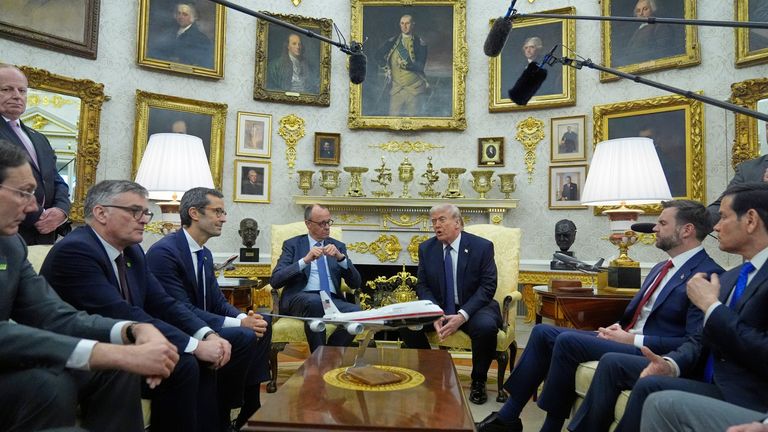
Friedrich Merz meeting Donald Trump in the Oval Office on Tuesday. Pic: AP
But Spain isn’t budging. Today, Prime Minister Pedro Sanchez addressed the nation, summing up his position in four words, “no to the war”.
He said this stance was by no means a sign of support for the Ayotollahs; instead, he was calling on Iran, Israel and the US to stop the fighting before it was too late.
“Twenty-three years ago, another US administration dragged us into a war with the Middle East. It triggered the largest wave of insecurity our continent has experienced since the fall of the Berlin Wall,” Mr Sanchez said.
He also warned that the war risked “playing Russian roulette” with millions of lives.
Clearly not afraid to challenge the US president further, he said governments were meant to improve people’s lives and provide solutions to problems, not make them worse, adding: “It is unacceptable that leaders who are incapable of fulfilling their duties try to cover up their failure with the smoke of war.”
Ouch!
Trump isn’t used to being so openly defied. As I write, we are still awaiting his reaction to this morning’s speech, but it feels unlikely that he will let it pass unchallenged.
Others have already reacted, the Spanish vice president of the European Commission, Teresa Ribera, throwing her weight behind her country, denouncing Trump’s threats as detrimental to global stability.
“The tension arising from this way of relating to third parties, whether it be British Prime Minister Keir Starmer, French President Emmanuel Macron, or Pedro Sanchez, is deeply disruptive for societies, for peace, cooperation, and also for the economy,” she said.
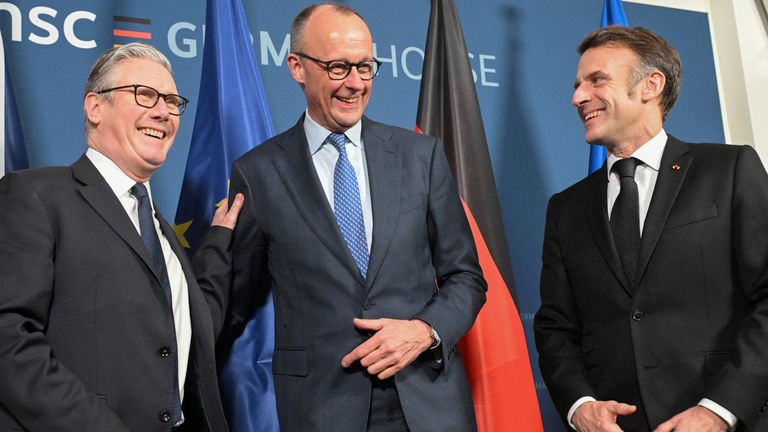
Sir Keir Starmer, Friedrich Merz and Emmanuel Macron are attempting to navigate a tense situation with Donald Trump. File pic: Reuters
Meanwhile, sources in France and Spain told us the French president was planning on calling Sanchez to show his allegiance.
In a softer tone last night, Emmanuel Macron joined the Spanish prime minister in calling the legality of the strikes into question, concluding that they were conducted “outside of international law” and that Paris “cannot approve of them”.
But what about Germany – the EU’s biggest beast?
While Friedrich Merz didn’t join Trump in his criticism of the Spanish stance on Iran, Germany’s chancellor certainly didn’t jump to Spain’s defence.
In fact, he later mentioned that they were still negotiating with Madrid to up their NATO contributions – another sore spot for the US president.
Read more from US News:
Was Iran ‘days’ from atomic weapons?
US allies fear shortage of weapons
Is AI giving US lethal edge in Iran?
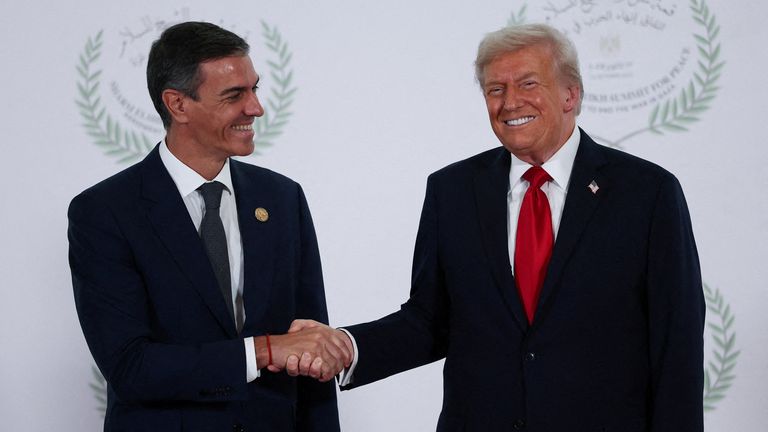
Donald Trump and Pedro Sanchez exchanging a warm greeting in October 2025. Pic: Reuters
When questioned by reporters about this later, the chancellor said he addressed the attacks on Spain and the UK in private, reminding Donald Trump that Spain is an EU member, so cannot be singled out for treatment.
“I did not want to escalate or prolong the debate publicly,” Merz explained.
While his reasoning – that an open challenge to Trump would have likely just enflamed the situation – makes sense given the experience of Zelenskyy last year, the Spanish are unimpressed.
Spain’s foreign minister expressed his “surprise” at the chancellor’s behaviour, pointedly remarking: “I cannot imagine Chancellor (Angela) Merkel or (Olaf) Scholz making such remarks.”
While other Spanish sources went further, saying: “Merz had an attitude not befitting a European leader who defends the unity of his partners.”
It seems by deciding not to antagonise Donald Trump, Friedrich Merz has put himself firmly in Madrid’s firing line.







Great article! This really puts things into perspective. I appreciate the thorough research and balanced viewpoint.
Interesting read, though I think there are some points that could have been explored further. Would love to see a follow-up on this topic.
Thanks for sharing this! I had no idea about some of these details. Definitely bookmarking this for future reference.
Well written and informative. The examples provided really help illustrate the main points effectively.
This is exactly what I was looking for! Clear, concise, and very helpful. Keep up the excellent work!