


Media Lens: Russia’s Missile and Drone Attack on Kyiv Kills 17, Damaging Infrastructure
Russia launched a missile attack on Kyiv, leading to the death of 17 individuals and significant destruction. The incident underscores the ongoing conflict’s impact on Ukraine’s air defenses.
Quick links: What has happened | Status quo | Confirmed facts | Preconceptions | Elisions | One story, four angles | Related links
What has happened
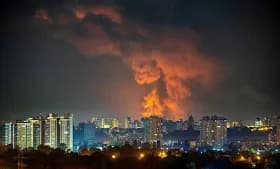
A recent missile attack on Kyiv, Ukraine, claimed the lives of 17 individuals and resulted in significant destruction at logistics warehouses. Reported by major news outlets including NPR, this strike has underscored the ongoing dangers facing the Ukrainian capital amidst the conflict with Russia.
The assault involved a combination of missile and drone strikes targeting urban areas, exploiting weaknesses in Ukraine’s air defense systems. Ukrainian authorities and defense officials condemned the violence, highlighting the escalating risks for civilians in contested regions.
Status quo
Ukraine has been facing increased attacks from Russia, with a recent missile strike resulting in the deaths of 17 individuals in a Ukrainian city. This assault has taken advantage of Ukraine’s weakened air defenses, which are struggling to cope with the heavy use of artillery and missile warfare on the eastern front. The ongoing conflict has prompted international concern over the humanitarian and military ramifications for Ukraine.
Confirmed facts
- Russia recently carried out a missile attack on Kyiv, exploiting Ukraine’s depleted air defenses.
- The attack resulted in the deaths of 17 individuals and caused significant damage to various infrastructures, including warehouses.
- Multiple sources, including The New York Times, Reuters, and NPR, reported on the missile attack and its aftermath.
- The incident is part of ongoing conflict-related events within Ukraine, further straining humanitarian conditions in the region.
Preconceptions
- The New York Times prioritizes the human toll of the missile attacks, highlighting individual casualties, whereas Reuters focuses on the physical destruction of infrastructure.
- NPR emphasizes the use of missile and drone tactics in the context of military strategy, while The Guardian downplays tactical analysis and instead addresses broader geopolitical implications.
- Reuters reports on the specifics of the ballistic attacks and their effects on logistics and warehouses, whereas The New York Times provides more narrative-driven stories around personal impacts.
- The Guardian addresses security incidents regarding NATO’s involvement in the European context, which is not covered in depth by the other outlets.
Elisions
- The New York Times coverage of the missile attacks emphasizes the impact on civilian infrastructure and the psychological toll on Ukrainians, while Reuters reports primarily on the military consequences and the number of casualties.
- NPR provides details on the logistics affected by the missile strikes, discussing damage to supply lines, whereas The Guardian focuses on international reactions and statements from NATO regarding the incidents.
- While all sources cover the immediate effects of the missile attacks, The Guardian uniquely highlights broader geopolitical implications, contrasting with NPR’s more localized viewpoint on the aftermath within Ukraine.
One story, four angles
The New York Times – Russia’s Deadly Missile Attack on Kyiv Exploits Ukraine’s Depleted Air Defenses
Publication: The New York Times | Intensity: (8/10) | Sentiment: Negative | Legal precision: High
Expand
Espresso Shot: The title emphasizes the efficacy of the missile attack, directing attention to the vulnerability of Ukraine’s air defenses first.
Key differences:
- Comparison: The use of “Deadly” underscores severity, contrasting with reports describing the event as merely “damaging.” Example: “Russia’s Deadly Missile Attack…” vs. “attack causes damage.”
- Comparison: Emphasizes strategic exploitation by suggesting intent, unlike outlets that focus on the event’s aftermath. Example: “Exploits Ukraine’s Depleted Air Defenses.”
- Comparison: High placement of casualty information elevates emotional impact; other headlines were less immediate. Example: “…Attack on Kyiv” leads the headline.
Bias: Selection: The headline focuses solely on negative impacts of the attack; other aspects, like international response, are omitted | Language: Uses “Deadly” and “Exploits,” framing Russia negatively | Omission: Lacks mention of any strategic military reaction from Ukraine.
Assessment: Readers likely perceive a one-sided narrative predominantly portraying Russian aggression and Ukrainian vulnerability.
Reuters – Russia kills 17 in heavy ballistic hit on Ukraine, destroys warehouses, logistics
Publication: Reuters | Intensity: (9/10) | Sentiment: Negative | Legal precision: Moderate
Expand
Espresso Shot: The headline emphasizes casualties and destruction from the attack, drawing immediate attention to human impact first.
Key differences:
- Comparison: “Kills 17” addresses human loss directly; other outlets may generalize about impact without specifics. Example: “casualties reported” vs. specifics.
- Comparison: Detailed emphasis on the destruction of “warehouses, logistics” quantifies economic ramifications, unlike more general headlines. Example: “destroys facilities.”
- Comparison: The phrase “heavy ballistic hit” signals military strength and seriousness, contrasting with softer descriptions elsewhere.
Bias: Selection: The headline highlights only negative outcomes, missing any discussion of defensive responses | Language: “Kills” evokes immediate emotional reactions compared to neutral language | Omission: Neglects the mention of civilian perspectives or humanitarian impacts.
Assessment: Readers likely recognize the incident as a significant tragedy, framing Russia as the aggressor with severe human consequences.
NPR – Russian missile and drone barrage in Ukrainian capital region kills 17
Publication: NPR | Intensity: (8/10) | Sentiment: Negative | Legal precision: Moderate
Expand
Espresso Shot: This headline highlights both missile and drone attacks, channeling focus on a multipronged assault approach by Russia first.
Key differences:
- Comparison: Unlike others, it mentions both “missile and drone,” showcasing military versatility. Example: “multi-faceted attack” contrasts with singular focus elsewhere.
- Comparison: The use of “barrage” implies an overwhelming attack, whereas different terms have been softer in descriptions. Example: “isolated incidents.”
- Comparison: Structure emphasizes both perpetrator and victim—placing “kills 17” in a direct focus—potentially eliciting empathy.
Bias: Selection: Centers solely on the hostility of the attack, neglecting potential conversations about peace | Language: “Barrage” evokes a sense of chaos, enhancing negative imagery for readers | Omission: Misses any mention of international implications or calls for diplomacy.
Assessment: Readers form a viewpoint of a calculated and ruthless military campaign, focusing on the urgent need for attention to the conflict’s human cost.
The Guardian – Nato confirms drone sighting near Ukrainian plane at German airport after ‘security incident’ – Europe live
Publication: The Guardian | Intensity: (7/10) | Sentiment: Neutral | Legal precision: Low
Expand
Espresso Shot: The headline places emphasis on NATO involvement, suggesting an ongoing geopolitical dimension to the story first.
Key differences:
- Comparison: Focus on NATO’s involvement creates a more diplomatic perspective, in contrast to other pieces highlighting direct military action. Example: “NATO confirms” rather than “Russia attacks.”
- Comparison: Positioning “security incident” as a matter of concern tempers the narrative, unlike more dramatic accounts of violence discussed elsewhere. Example: “security incident” sounds less dire.
- Comparison: Less human-centered approach, focusing instead on institutional responses, unlike the casualty-driven narratives of others.
Bias: Selection: Highlights NATO’s role over human consequences of the attacks | Language: “Security incident” downplays urgency compared to “deadly” or “kills” terminology used by peers | Omission: Skips the immediate reaction from those impacted by the attacks.
Assessment: Readers may perceive a focus on international relations rather than the immediate dangers faced by those on the ground in Ukraine.
In comparing coverage of recent missile attacks on Ukraine, The New York Times emphasizes the implications of depleted air defenses, portraying a somber reality for civilians, while Reuters opts for a more escalatory tone by focusing explicitly on casualties and destruction, framing the situation as a dire escalation of violence. NPR strikes a balance, acknowledging both the human cost and the military context. Ultimately, The New York Times provides the most restrained framing, while Reuters offers the starkest depiction of the violence. The facts do not change. What changes is where scrutiny lands.
Related links
The New York Times
Russia’s Deadly Missile Attack on Kyiv Exploits Ukraine’s Depleted Air Defenses
Reuters
Russia kills 17 in heavy ballistic hit on Ukraine, destroys warehouses, logistics
NPR
Russian missile and drone barrage in Ukrainian capital region kills 17














Great article! This really puts things into perspective. I appreciate the thorough research and balanced viewpoint.
Interesting read, though I think there are some points that could have been explored further. Would love to see a follow-up on this topic.
Thanks for sharing this! I had no idea about some of these details. Definitely bookmarking this for future reference.
Well written and informative. The examples provided really help illustrate the main points effectively.
This is exactly what I was looking for! Clear, concise, and very helpful. Keep up the excellent work!