


Media Lens: Nepal flood deaths surpass 900 with hundreds of workers trapped in tunnels
In Nepal, flooding has resulted in over 900 fatalities as of recent reports. Hundreds of workers are feared trapped in hydropower tunnels amid the ongoing disaster.
Quick links: What has happened | Status quo | Confirmed facts | Preconceptions | Elisions | One story, four angles | Related links
What has happened
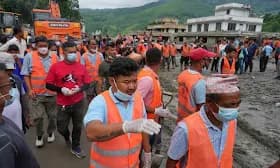
Recent flooding in Nepal has resulted in over 900 fatalities, with many others missing, particularly workers trapped in hydropower tunnels. Rescue efforts are ongoing as authorities grapple with the extent of the disaster amid heavy monsoon rains impacting the region.
The floods have sparked concerns regarding the adequacy of infrastructure and disaster preparedness in Nepal. Local officials have expressed apprehension about accepting foreign assistance, complicating the relief efforts in the affected areas.
Status quo
Nepal is currently experiencing severe flooding, leading to significant casualties and displacement. Reports indicate that the death toll has exceeded 900, with hundreds of workers feared trapped in hydropower tunnels. The region has faced heavy rainfall, causing widespread destruction and hampering rescue efforts. Government officials and aid organizations are mobilizing to address the crisis, although challenges remain in reaching affected areas and ensuring adequate relief measures.
Confirmed facts
- Over 900 people have died due to floods in Nepal.
- Hundreds of workers are feared to be stuck in hydropower tunnels because of the flooding.
- The Nepali government has been hesitant to accept foreign aid for flood relief efforts.
- Rescue operations are ongoing as authorities attempt to respond to the crisis.
Preconceptions
- AP News prioritizes the human toll of the Nepal floods, emphasizing the increasing death toll and the plight of trapped workers in hydropower tunnels, with a direct quote from local officials featured prominently.
- The New York Times focuses on the cultural aspects leading up to the floods, featuring the narrative of Hindu pilgrims at Mount Kailash, which may distract from the immediate disaster response.
- NPR highlights governmental hesitance to accept foreign aid, emphasizing diplomatic considerations and the implications for disaster response, while reducing focus on immediate humanitarian needs.
- The Guardian critiques the opacity surrounding the scale of the disaster from the Chinese perspective, which emphasizes geopolitical concerns over local humanitarian crises compared to other outlets.
Elisions
- AP News highlights the human toll of the floods in Nepal, reporting that over 900 have died, while The New York Times emphasizes the cultural and religious aspects surrounding Mount Kailash as a pilgrimage site but lacks depth on the disaster’s immediate impact.
- NPR discusses Nepal’s reluctance to accept international aid in the face of the disaster, while The Guardian focuses on how China’s handling of related issues is perceived as deceptive, with no source addressing the international aid response comprehensively.
- While several sources cover the death toll and damage, none provide detailed statistics on the economic impact of the floods, such as loss in agriculture and infrastructure, which may hinder long-term recovery insights.
One story, four angles
AP News – Hundreds of workers feared stuck in hydropower tunnels as Nepal flood deaths cross 900
Publication: AP News | Intensity: (8/10) | Sentiment: -1 | Legal precision: High
Expand
Espresso Shot: The report prioritizes the urgent human tragedy, highlighting the humans stuck underground over the overall death toll, directing the reader’s immediate attention to the plight of trapped workers.
Key differences:
– Insight 1: Emphasis on individual human stories compared to other outlets. AP opens with the plight of “hundreds of workers” versus a more statistic-centric approach from NPR.
– Insight 2: Focus on immediate consequences and rescue efforts (‘stuck’) rather than political implications, contrasting sharply with The Guardian’s coverage emphasizing political critiques of disaster management.
– Insight 3: Presentation of geographical context through detailed imagery of hydropower tunnels captures immediacy, unlike NPR’s broader narrative approach.
Bias: Selection: Focuses primarily on the human aspect of the disaster. | Language: Use of emotionally charged phrases like “feared stuck” amplifies urgency. | Omission: Less emphasis on government response compared to other media.
Assessment: Readers are first led to internalize the dire personal impacts of the tragedy through vivid human-centric storytelling.
NPR – Nepal’s hesitance to accept foreign help for flood relief under scrutiny
Publication: NPR | Intensity: (7/10) | Sentiment: 0 | Legal precision: Medium
Expand
Espresso Shot: This article directs the reader’s focus toward governmental decisions and political implications surrounding international aid, framing reluctance as a critical part of the flood response narrative.
Key differences:
– Insight 1: NPR emphasizes bureaucratic scrutiny over personal loss, shaping a narrative that distances from the immediate tragedy to broader governmental issues.
– Insight 2: Direct quotations from officials enhance authority but may obscure individual experiences, contrasting with AP’s human-centric narratives.
– Insight 3: The piece often recycles the same information about the government’s hesitance without adding new context, leading to a potentially repetitive reading experience.
Bias: Selection: Focus on political criticism rather than on tragic human stories. | Language: Uses formal language which could alienate the emotional gravity of events. | Omission: Lacks the personal narratives present in AP and The Guardian.
Assessment: Readers initially perceive the situation through a lens of governmental inefficacy over immediate human suffering.
The Guardian – China is concealing scale of flood disaster, say Tibet campaigners
Publication: The Guardian | Intensity: (6/10) | Sentiment: -1 | Legal precision: Medium
Expand
Espresso Shot: The headline foregrounds allegations against China, directing readers’ focus to political criticisms rather than directly engaging with the impacts of the flooding in Nepal itself.
Key differences:
– Insight 1: The Guardian ties the flooding in Nepal to broader geopolitical narratives, a stark contrast to the human stories highlighted by AP and NPR’s scrutiny of local governance.
– Insight 2: Use of “conceal” in the headline suggests deliberate governmental malfeasance, altering reader perception towards suspicion rather than empathy.
– Insight 3: By spotlighting Tibet campaigners, it adds a layer of activist perspective missing from more neutral coverage, which could either inform or alienate certain readers.
Bias: Selection: Focuses largely on geopolitical implications rather than individual impacts. | Language: “Concealing” implies deliberate obstruction, framing China negatively. | Omission: Minimal coverage of the human tragedies occurring at local levels.
Assessment: Readers first perceive a crisis framed through a lens of international diplomacy rather than human suffering.
In examining the coverage of Nepal’s floods, AP News emphasizes the human cost with a focus on the hundreds of workers feared trapped, reflecting a humanitarian urgency. In contrast, NPR highlights Nepal’s hesitance to accept foreign aid, framing the situation within a political context, which could escalate scrutiny regarding governmental actions. The New York Times provides a broader historical lens, blending cultural elements with the flooding narrative. Lastly, The Guardian addresses allegations of disaster concealment by China, amplifying concerns of geopolitical tensions. The strongest approach highlights immediate human impacts, while escalatory frames incite scrutiny of political implications. The facts do not change. What changes is where scrutiny lands.
Related links
AP News
Hundreds of workers feared stuck in hydropower tunnels as Nepal flood deaths cross 900
The New York Times
Before Nepal’s Floods, Hindu Pilgrims Sought the Divine at Mount Kailash
NPR
Nepal’s hesitance to accept foreign help for flood relief under scrutiny
The Guardian
China is concealing scale of flood disaster, say Tibet campaigners












Great article! This really puts things into perspective. I appreciate the thorough research and balanced viewpoint.
Interesting read, though I think there are some points that could have been explored further. Would love to see a follow-up on this topic.
Thanks for sharing this! I had no idea about some of these details. Definitely bookmarking this for future reference.
Well written and informative. The examples provided really help illustrate the main points effectively.
This is exactly what I was looking for! Clear, concise, and very helpful. Keep up the excellent work!