


Get you up to speed: European Commission‘s “One Europe, One Market” Strategy to Boost Competitiveness
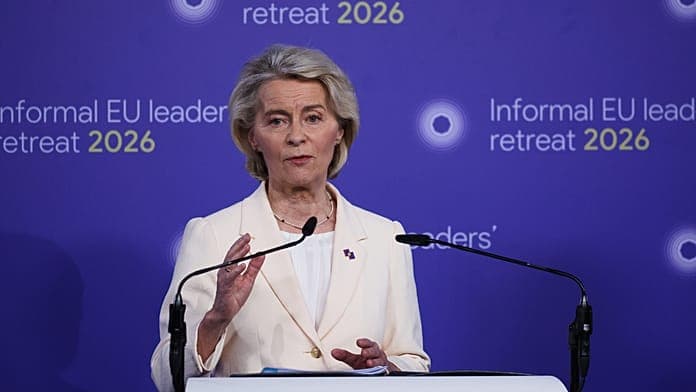
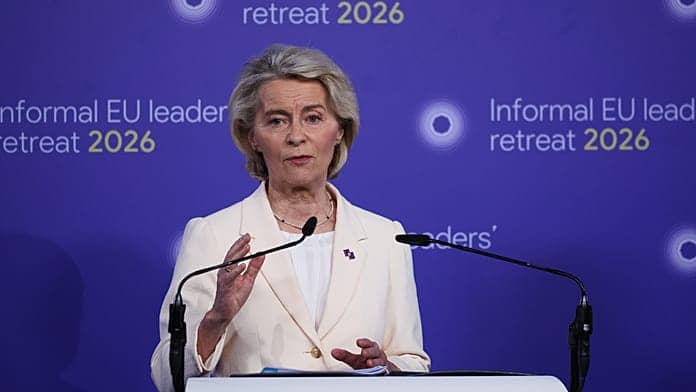
European Commission President Ursula von der Leyen unveiled the “One Europe, One Market” strategy at the EU leaders‘ summit on 12 February. The plan aims to transform the fragmented single market within two years to enhance Europe’s competitiveness against the US and China.
Ursula von der Leyen highlighted that Europe is currently hindered by “interstate barriers” which are significantly higher than in the US. The International Monetary Fund’s prediction emphasises the urgency of this initiative, forecasting that the EU’s global GDP share will drop to 12.91% by 2030.
The Commission will focus on five key pillars: regulatory simplification, unified market, trade, digital, and energy. A detailed roadmap is expected at the March 2026 European Council, with early milestones including a target to deliver the first phase of the Savings and Investment Union by June 2026.
What we know so far
‘One Europe, One Market’: The Commission’s last attempt to boost competitiveness
European Commission President Ursula von der Leyen announced the “One Europe, One Market” strategy at the EU leaders’ summit on 12 February. The aim is to eliminate interstate barriers and enhance Europe’s competitiveness against the US and China. “We have the second-largest economy in the world, but we are driving it with the handbrake,” von der Leyen stated.
The International Monetary Fund’s projections indicate that the EU will account for only 12.91% of global GDP in 2030. In light of this, von der Leyen stressed the need for a “deep house cleaning on the acquis” to simplify regulations, as current complexities have led to multiple regulatory realities across member states.
The strategy identifies five pillars to drive change: regulatory simplification, a unified market, trade, digital initiatives, and energy. By adopting new measures quickly, EU leaders aim to tackle issues that increase business costs and affect innovation in sectors like AI and biotech, as warned by various leaders including Enrico Letta.
Another challenge highlighted is Europe’s reliance on external suppliers, prompting calls for strategic autonomy in sectors including defence and energy. The Commission promised a detailed roadmap at the March 2026 European Council, with the first phase of the Savings and Investment Union expected to be delivered by June 2026.
The Commission is also working on simplifying the administrative burden for businesses through “omnibus” packages, which bundle legislative reforms. Currently, ten such packages are in motion, with an aim to reduce red tape costs by approximately €15 billion per year for businesses.
Ultimately, the vision of a united market includes creating a single optional EU-wide corporate framework, enabling firms to set up and operate seamlessly across Europe. A proposal for this framework is expected before the March 2026 deadline. Leaders also intend to reconsider energy market designs to enhance independence and efficiency within the EU.






Great article! This really puts things into perspective. I appreciate the thorough research and balanced viewpoint.
Interesting read, though I think there are some points that could have been explored further. Would love to see a follow-up on this topic.
Thanks for sharing this! I had no idea about some of these details. Definitely bookmarking this for future reference.
Well written and informative. The examples provided really help illustrate the main points effectively.
This is exactly what I was looking for! Clear, concise, and very helpful. Keep up the excellent work!